Is a Small Business Loan Secured or Unsecured? Key Differences Explained (2026 Guide)
When business owners begin searching for funding, one of the most common questions they ask is: is a small business loan secured or unsecured?
The answer is that small business loans can be either secured or unsecured, depending on the lender, loan amount, and the borrower’s financial profile. Some loans require collateral such as property or equipment, while others are approved based on your creditworthiness and business revenue.
Understanding the difference between secured and unsecured business loans is essential because it affects interest rates, loan limits, approval speed, and financial risk. In this guide, we’ll explain how both types of loans work and help you determine which option may be best for your business.
Many entrepreneurs also explore flexible funding options through lenders such as NF Funding, which provide different financing solutions tailored to small businesses.
Is a Small Business Loan Secured or Unsecured?
A small business loan can be secured or unsecured, depending on whether the lender requires collateral.
A secured business loan requires the borrower to pledge assets—such as property, equipment, or inventory—as collateral for the loan. If the borrower fails to repay the loan, the lender may claim the collateral.
An unsecured business loan, on the other hand, does not require physical collateral. Instead, lenders evaluate factors such as credit score, business revenue, and financial history to determine eligibility.
What Is a Secured Small Business Loan?
A secured small business loan is a loan backed by collateral that the lender can claim if the borrower fails to repay the debt.
Collateral reduces the lender’s risk, which is why secured loans often offer larger loan amounts and lower interest rates compared to unsecured loans.
Common types of collateral include:
Commercial real estate
Business equipment
Inventory
Vehicles
Accounts receivable
Personal assets in some cases
Because lenders have a financial safety net, they are usually more willing to approve larger funding amounts for secured loans.
What Is an Unsecured Small Business Loan?
An unsecured small business loan does not require the borrower to pledge collateral.
Instead, lenders evaluate the borrower based on financial strength, including:
Credit score
Business revenue
Length of time in business
Cash flow stability
Because unsecured loans carry more risk for lenders, they usually come with:
higher interest rates
lower borrowing limits
shorter repayment terms
However, many businesses prefer unsecured loans because they do not risk losing valuable assets.
Key Differences Between Secured and Unsecured Business Loans
Understanding the differences between these two types of loans can help you choose the right financing option.
Feature
Secured Business Loan
Unsecured Business Loan
Collateral
Required
Not required
Interest rates
Lower
Higher
Loan amount
Higher
Lower
Approval speed
Slower
Faster
Risk to borrower
Asset risk
No asset risk
The best option depends on your business’s financial situation and how quickly you need funding.
When Should You Choose a Secured Business Loan?
A secured loan may be the better choice if your business needs larger amounts of capital or long-term financing.
Situations where secured loans are often used include:
Business Expansion
Companies expanding operations may need significant funding to open new locations or hire additional staff.
Equipment Purchases
Businesses purchasing expensive equipment often secure loans using the equipment itself as collateral.
Commercial Property Purchases
Secured loans are commonly used for commercial real estate investments.
Lower Interest Rate Goals
Businesses seeking lower borrowing costs often choose secured financing.
When Should You Choose an Unsecured Business Loan?
Unsecured loans can be ideal for businesses that need quick access to smaller amounts of funding.
Common situations include:
Short-Term Cash Flow Needs
Businesses experiencing temporary cash flow gaps may prefer unsecured financing.
Fast Funding Requirements
Unsecured loans usually have faster approval processes than secured loans.
Businesses Without Collateral
Startups or service-based businesses may not have physical assets to pledge as collateral.
Types of Secured Small Business Loans
Several types of secured loans are available to businesses depending on their financing needs.
Equipment Financing
Businesses can use equipment itself as collateral for loans used to purchase machinery or tools.
Commercial Real Estate Loans
These loans are secured by commercial property used for business operations or investment purposes.
Inventory Financing
Retailers and wholesalers may use inventory as collateral for working capital loans.
Invoice Financing
Businesses can use outstanding invoices as collateral to receive immediate funding.
Types of Unsecured Small Business Loans
Unsecured financing options are popular among small businesses seeking flexible funding.
Business Lines of Credit
A revolving credit line that businesses can draw from when needed.
Merchant Cash Advances
Funding based on future credit card sales.
Short-Term Business Loans
These loans provide fast capital with repayment periods typically under two years.
Revenue-Based Financing
Repayments are based on a percentage of business revenue.
Many business owners explore these options through lenders such as NF Funding, which offer flexible financing solutions.
Which Small Business Loan Is Easier to Get?
Whether a secured or unsecured loan is easier to obtain depends on the borrower’s financial profile.
Secured loans may be easier to qualify for if:
you have valuable collateral
your credit score is lower
you need a large loan amount
Unsecured loans may be easier if:
you have strong credit
your business generates stable revenue
you need smaller funding quickly
Lenders evaluate multiple factors before approving business financing.
Pros and Cons of Secured Business Loans
Advantages
Lower interest rates
Higher borrowing limits
Longer repayment terms
Disadvantages
Risk of losing collateral
Longer approval process
Additional documentation required
Pros and Cons of Unsecured Business Loans
Advantages
No collateral required
Faster approval times
Easier application process
Disadvantages
Higher interest rates
Smaller loan amounts
Shorter repayment terms
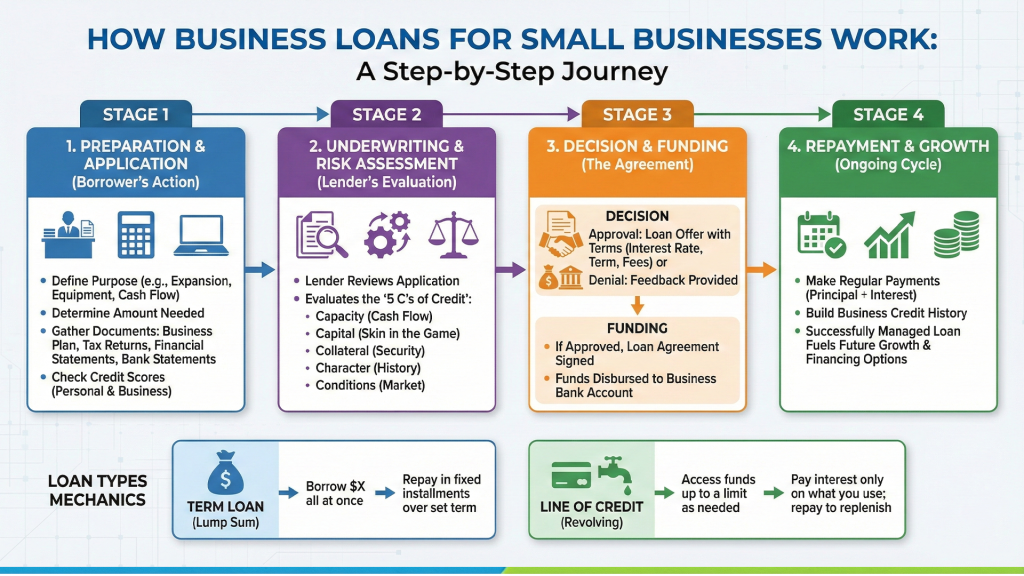
How to Qualify for a Small Business Loan
Lenders typically evaluate several key factors before approving a business loan.
Common requirements include:
Business financial statements
Credit score and credit history
Revenue documentation
Time in business
Business plan or funding purpose
Preparing these documents in advance can improve your chances of approval.
How to Apply for a Small Business Loan
Applying for a business loan generally involves several steps.
Step 1: Determine Your Financing Needs
Decide how much funding your business requires and how it will be used.
Step 2: Choose the Right Loan Type
Select between secured or unsecured financing based on your business situation.
Step 3: Gather Financial Documents
Prepare bank statements, tax returns, and financial records.
Step 4: Compare Lenders
Research lenders offering competitive loan terms.
Step 5: Submit Your Application
Complete the loan application and provide supporting documentation.
Businesses seeking flexible funding solutions often consider lenders such as NF Funding for their financing needs.
Frequently Asked Questions
Are most small business loans secured?
Many traditional bank loans are secured, especially for large loan amounts. However, many alternative lenders offer unsecured business loans for smaller funding needs.
Can you get a business loan without collateral?
Yes. Many lenders offer unsecured business loans that do not require collateral, although they may have higher interest rates and stricter credit requirements.
What credit score is needed for an unsecured business loan?
Most lenders require a credit score of around 650 or higher, although requirements may vary depending on the lender and loan type.
What assets can be used as collateral for a business loan?
Common forms of collateral include commercial property, equipment, inventory, vehicles, and accounts receivable.
Final Thoughts
So, is a small business loan secured or unsecured?
The answer is that both options exist, and the best choice depends on your business’s financial situation, funding needs, and risk tolerance.
Secured loans generally offer larger funding amounts and lower interest rates, while unsecured loans provide faster approvals and eliminate the need for collateral.
By understanding the differences between these financing options, business owners can choose the loan structure that best supports their growth strategy.
For businesses exploring flexible financing options, experienced lenders such as NF Funding provide funding solutions designed to support small business growth and expansion.
How to Create a Real Estate Investment Fund: Complete Guide for 2026
Real estate investment funds have become one of the most effective ways to build long-term wealth through property markets. Instead of investing in a single property, investors can pool capital and purchase multiple real estate assets under professional management.
If you are wondering how to create a real estate investment fund, the process requires careful planning, legal compliance, and a strong investment strategy. Real estate funds are typically created by experienced investors, financial institutions, or development companies looking to scale their property portfolios.
Organizations such as NF Funding provide financing and advisory support for property investment strategies, helping investors structure sustainable funding models.
In this guide, we will explain the step-by-step process of creating a real estate investment fund, including capital requirements, legal structure, and operational management.
What Is a Real Estate Investment Fund?
A real estate investment fund is a pooled investment structure that collects money from multiple investors to purchase, manage, and generate income from real estate assets.
These funds are usually managed by professional fund managers who make investment decisions on behalf of investors.
Real estate funds may invest in:
Commercial office buildings
Residential rental properties
Industrial warehouses
Retail shopping centers
Mixed-use development projects
The primary goal is to generate returns through rental income, property appreciation, or asset resale.
Why Create a Real Estate Investment Fund?
Creating a real estate investment fund provides several strategic advantages.
First, it allows investors to diversify risk by spreading capital across multiple properties rather than relying on a single asset.
Second, real estate funds enable access to large commercial property deals that may be difficult for individual investors to purchase alone.
Third, investment funds can generate passive income streams through rental collections and long-term asset appreciation.
Many investors exploring property financing structures consider working with experienced financial partners such as NF Funding.
Types of Real Estate Investment Funds
Private Real Estate Funds
Private funds are limited to a specific group of investors.
Advantages include greater control over investment strategy and decision-making.
These funds are commonly used by high-net-worth individuals and institutional investors.
Public Real Estate Funds
Public real estate funds allow wider investor participation through regulated financial markets.
They are generally more liquid but involve stricter regulatory compliance.
Commercial Property Investment Funds
Commercial funds focus on assets such as:
Office buildings
Retail centers
Industrial facilities
These funds usually target long-term rental income and stable returns.
Step-by-Step Process to Create a Real Estate Investment Fund
Step 1: Define Investment Strategy
The first step is determining the fund’s investment direction.
You must decide:
Target property type
Geographic investment area
Risk tolerance level
Expected return rate
Holding period for assets
A clear investment strategy helps attract investors and improves fund performance.
Step 2: Choose the Legal Structure
Legal structure is extremely important when creating an investment fund.
Common structures include:
Limited partnership models
Limited liability companies
Trust-based investment structures
Consulting legal and financial professionals is recommended to ensure compliance with financial regulations.
Step 3: Register the Investment Fund
Fund registration requirements vary by country and financial jurisdiction.
Typical registration steps include:
Business entity formation
Regulatory approval application
Financial compliance documentation
Investment disclosure policies
Proper registration protects both investors and fund managers.
Step 4: Raise Initial Capital
Capital raising is one of the most important stages of fund creation.
Investment capital can be collected from:
Private investors
Institutional partners
Accredited investment groups
Development financing programs
Networking and professional financial partnerships are often necessary during this phase.
Investors may explore flexible financing solutions through providers such as NF Funding.
Step 5: Acquire Real Estate Assets
After capital formation, the fund begins property acquisition.
Investment decisions should be based on:
Market demand analysis
Rental yield potential
Location growth trends
Property condition and valuation
Professional market research improves investment success probability.
Step 6: Manage Fund Portfolio
Asset management is crucial for maintaining long-term profitability.
Fund management responsibilities include:
Property maintenance
Tenant relationship management
Financial performance monitoring
Operational cost optimization
Risk management
Many successful funds employ experienced property management teams.
Step 7: Generate and Distribute Returns
Investment returns are generated through multiple channels.
Primary income sources include:
Monthly rental income
Property appreciation value
Commercial lease agreements
Strategic property sales
Return distribution methods depend on the fund agreement structure.
How Much Capital Is Needed to Start a Real Estate Investment Fund?
The required capital depends on the scale of the investment fund.
Fund Size
Estimated Starting Capital
Small Private Fund
$100,000 – $1 million
Medium Investment Fund
$1 million – $10 million
Institutional Fund
$10 million+
Larger funds allow more diversified property portfolios.
Risks of Real Estate Investment Funds
Like any investment model, real estate funds involve certain risks.
Market Price Fluctuation
Property market values can change due to economic conditions.
Liquidity Risk
Real estate assets are not as easily sold as stocks.
Management Risk
Poor property management can reduce profitability.
Regulatory Risk
Financial compliance requirements must be followed.
Proper risk assessment strategies are essential for sustainable fund operation.
Benefits of Creating a Real Estate Investment Fund
Key advantages include:
Portfolio diversification
Passive income generation
Access to large property transactions
Professional asset management
Long-term wealth building
Real estate investment funds are particularly attractive for investors seeking stable, inflation-resistant assets.
Who Should Create a Real Estate Investment Fund?
Real estate investment funds are suitable for:
Property developers
High-net-worth investors
Financial institutions
Commercial real estate operators
Long-term investment planners
Working with financing experts such as NF Funding can help structure investment strategies.
Frequently Asked Questions
How long does it take to create a real estate investment fund?
The setup process may take several months to a year depending on legal approval and capital formation.
Is a real estate investment fund profitable?
Profitability depends on market conditions, asset management quality, and investment strategy.
Do I need a license to start a real estate fund?
Many jurisdictions require financial regulatory approval to operate investment funds.
Can small investors participate in real estate funds?
Yes, private fund models may allow smaller investor participation depending on fund policy.
Final Thoughts
Creating a real estate investment fund is a powerful strategy for building long-term financial growth and portfolio diversification.
However, success requires careful planning, legal compliance, and professional management. Investors should focus on market research, risk assessment, and sustainable property acquisition strategies.
If you are exploring property investment financing or fund structuring options, professional financial partners such as NF Funding can provide guidance and flexible funding solutions tailored to your investment goals.
How Much Can I Borrow on a Bridging Loan? Complete Guide for Property Investors (2026)
How Much Can I Borrow on a Bridging Loan: Bridging loans have become an increasingly popular financing solution for property buyers, real estate investors, and developers who need quick access to capital. However, one of the most common questions borrowers ask is: how much can I borrow on a bridging loan?
The answer depends on several factors, including the value of the property, loan-to-value (LTV) ratio, lender requirements, and your planned exit strategy. In most cases, borrowers can secure between 60% and 75% of the property’s value, although some lenders may offer up to 80% LTV under the right conditions.
In this guide, we’ll explain how bridging loan amounts are calculated, what affects borrowing limits, and how you can maximize the amount you qualify for. How Much Can I Borrow on a Bridging Loan
What Is a Bridging Loan?
A bridging loan is a short-term property financing solution designed to “bridge the gap” between a current financial need and a longer-term funding option.
These loans are typically used when borrowers need fast access to funds, especially in property transactions where timing is critical.
Common situations where bridging loans are used include:
Purchasing a new property before selling an existing one
Buying properties at auction with tight completion deadlines
Financing property renovations or developments
Securing investment opportunities quickly
Most bridging loans have terms ranging from 3 months to 24 months and are secured against property or real estate assets.
Many investors choose lenders such as NF Funding because they specialize in flexible short-term property financing.
How Much Can You Borrow on a Bridging Loan?
In most cases, bridging lenders allow borrowers to access 60% to 75% of the property’s value, known as the loan-to-value ratio (LTV).
Some lenders may provide up to 80% LTV depending on factors such as the borrower’s experience, credit profile, and the property being used as collateral.
Example Borrowing Scenarios
Property Value
Typical Loan Range
$250,000
$150,000 – $187,500
$500,000
$300,000 – $375,000
$750,000
$450,000 – $562,500
$1,000,000
$600,000 – $750,000
These figures represent general guidelines. The exact amount you can borrow will depend on your lender’s criteria and the strength of your overall application.
Key Factors That Determine How Much You Can Borrow
Several factors influence how much funding a lender is willing to offer. Understanding these factors can help you prepare a stronger application.
Property Value
The value of the property used as collateral is the most important factor in determining your loan amount.
Lenders typically require a professional valuation to determine the market value of the property. The higher the property value, the more you may be able to borrow.
Loan-to-Value Ratio (LTV)
The loan-to-value ratio represents the percentage of the property’s value that the lender is willing to finance.
For example:
Property Value: $400,000 Maximum LTV: 70%
Maximum Loan Amount:
$280,000
Higher LTV loans carry more risk for lenders, which is why they may require additional documentation or security.
Your Exit Strategy | How Much Can I Borrow on a Bridging Loan
A strong exit strategy is critical for bridging loan approval.
Lenders want to know exactly how you plan to repay the loan when the term ends.
Common exit strategies include:
Selling the property after renovation
Refinancing into a long-term mortgage
Selling another property to repay the loan
Business or investment income
The clearer and more realistic your exit strategy is, the more comfortable lenders will be approving larger loan amounts.
Property Type
The type of property being financed can affect borrowing limits.
Lenders may offer different terms for:
Residential properties
Commercial properties
Mixed-use properties
Land or development sites
For example, residential properties typically receive higher LTV ratios compared to development land.
Borrower Experience
Experienced property investors or developers often qualify for higher loan amounts.
Lenders prefer borrowers who have:
A history of successful property investments
Previous renovation or development projects
Strong financial profiles
Specialist lenders like NF Funding often work with investors and developers who need flexible funding structures.
Maximum Bridging Loan Amounts
Bridging loan sizes can vary significantly depending on the lender and project.
Typical ranges include: How Much Can I Borrow on a Bridging Loan
Lender Type
Typical Loan Amount
Small private lenders
$50,000 – $500,000
Specialist property lenders
$250,000 – $5 million
Institutional lenders
$1 million – $25 million+
Large property developments and commercial projects may qualify for multi-million-dollar bridging loans.
How to Increase the Amount You Can Borrow | How Much Can I Borrow on a Bridging Loan
If you want to maximize your borrowing potential, there are several strategies you can use.
Offer Additional Security | How Much Can I Borrow on a Bridging Loan
Providing another property as collateral can significantly increase the amount you can borrow.
This reduces the lender’s risk and may allow for a higher LTV.
Increase Your Deposit
A larger deposit lowers the loan-to-value ratio, making lenders more comfortable offering larger loans.
For example:
Property Value: $500,000 Deposit: $150,000
Loan Required: $350,000
This creates a lower LTV and increases approval chances.
Strengthen Your Exit Strategy | How Much Can I Borrow on a Bridging Loan
A well-documented exit strategy reassures lenders that the loan will be repaid on time.
Providing details such as:
property sale timeline
refinancing pre-approval
investment projections
can improve your application.
Work With Specialist Bridging Lenders | How Much Can I Borrow on a Bridging Loan
Traditional banks often have strict lending requirements.
Specialist lenders like NF Funding can provide more flexible lending options, particularly for property investors and developers.
Bridging Loan Example Calculation
Let’s look at a practical example.
Property Purchase Price: $600,000 Maximum LTV: 70%
Maximum Loan Amount:
$420,000
Typical costs may include:
valuation fees
lender arrangement fees
legal fees
monthly interest payments
These costs should always be factored into your investment strategy.
Advantages of Bridging Loans | How Much Can I Borrow on a Bridging Loan
Bridging finance offers several advantages compared to traditional loans.
Fast Access to Capital
Bridging loans can often be approved within 24 to 72 hours, with funding completed in 5 to 14 days.
Flexible Lending Criteria
Lenders focus more on the property value and exit strategy than strict income requirements.
Ideal for Property Investments
Investors can secure time-sensitive opportunities that would otherwise be lost with slower financing options.
Potential Risks of Bridging Loans
While bridging loans can be powerful financial tools, they also come with risks.
Higher Interest Rates
Because they are short-term loans, interest rates are typically higher than traditional mortgages.
Short Repayment Period
Borrowers must repay the loan within a short timeframe, often less than two years.
Property Risk
Failure to repay the loan could result in the lender repossessing the property used as collateral.
Proper planning and a clear exit strategy can help mitigate these risks.
Who Uses Bridging Loans?
Bridging loans are commonly used by:
Property investors
Real estate developers
Auction property buyers
Homeowners purchasing before selling
Commercial property buyers
These borrowers often require fast, flexible financing to secure property opportunities.
How Fast Can You Get a Bridging Loan? | How Much Can I Borrow on a Bridging Loan
One of the biggest advantages of bridging finance is speed.
Typical timelines include:
Application review: 24–48 hours Loan approval: 2–5 days Funding completion: 5–14 days
Experienced lenders such as NF Funding specialize in quick approvals for property-based financing.
Bridging Loan Eligibility Requirements | How Much Can I Borrow on a Bridging Loan
While requirements vary by lender, most bridging loan applications require:
Property collateral
Proof of ownership or purchase agreement
Exit strategy plan
Property valuation
Basic financial documentation
Because the property secures the loan, eligibility requirements are often more flexible than traditional bank loans.
Frequently Asked Questions: How Much Can I Borrow on a Bridging Loan
How much deposit do I need for a bridging loan?
Most lenders require a deposit between 20% and 40% of the property value, depending on the loan-to-value ratio offered.
What is the maximum LTV for bridging loans?
Most bridging lenders offer 60% to 75% LTV, although some may provide up to 80% LTV under certain conditions.
Can I get a bridging loan with bad credit?
Yes, it is possible. Because bridging loans are secured against property, lenders often focus more on the value of the asset and exit strategy than credit history.
How long do bridging loans last?
Bridging loans typically last between 3 months and 24 months, depending on the lender and project.
Final Thoughts: How Much Can I Borrow on a Bridging Loan
So, How Much Can I Borrow on a Bridging Loan?
In most situations, borrowers can access 60% to 75% of a property’s value, with some lenders offering up to 80% LTV depending on the circumstances.
The exact loan amount will depend on several factors, including the property value, exit strategy, and lender criteria. For property investors and developers, bridging loans provide a fast and flexible way to secure time-sensitive opportunities.
If you are considering short-term property financing, working with an experienced lender such as NF Funding can help you explore funding solutions tailored to your investment goals.
Introduction to Permanent Financing for Commercial Real Estate
Permanent Financing for Commercial Real Estate: Investing in commercial real estate requires not only capital but also a well-structured financing strategy. While short-term solutions like bridge loans and construction financing can help acquire or renovate properties, permanent financing for commercial real estate is essential for long-term stability, predictable cash flow, and sustainable growth.
Permanent financing refers to long-term loans—typically ranging from 10 to 30 years—used to fund stabilized, income-producing commercial properties. Unlike short-term loans, permanent financing allows borrowers to lock in low interest rates, secure predictable monthly payments, and plan for long-term operations or portfolio expansion.
A primary benefit of permanent financing is predictability. Investors can forecast monthly payments, operating expenses, and ROI with confidence, enabling effective financial planning. Additionally, long-term financing often comes with lower interest rates compared to short-term loans, reducing the overall cost of capital.
In today’s competitive real estate market, permanent financing also enables investors to refinance short-term loans or bridge financing into longer-term debt. This strategy helps maximize leverage, reduce risk, and stabilize operations across multiple properties.
By the end of this guide, you will understand how permanent financing works, the types available, eligibility requirements, interest rates and fees, real-world applications, and how to integrate it into a long-term investment strategy. This content is optimized for SEO, AEO, and GEO, making it suitable for international audiences, commercial investors, and real estate professionals seeking authoritative guidance.
What Is Permanent Financing in Commercial Real Estate?
Permanent financing is a long-term loan used to finance income-producing commercial properties. Unlike short-term solutions, it is not meant for acquisitions under construction or temporary cash flow gaps but for stabilized properties generating rental income.
Key Features Include:
Term Length: Typically 10–30 years, providing long-term financial stability
Amortization: Structured repayment of principal and interest over the life of the loan
Interest Rates: Fixed or variable, often lower than short-term loans due to reduced risk
Collateral: Secured by the property being financed, ensuring lower risk for the lender
Permanent financing is ideal for investors who want to lock in predictable payments, manage long-term cash flow, and refinance short-term loans after property stabilization. It allows for strategic planning, whether the property is part of a growing portfolio or a standalone investment.
How Permanent Financing Works
Understanding the mechanics of permanent financing is crucial for strategic use:
Loan Structure
Principal and interest are amortized over the loan term.
Some loans may allow interest-only periods initially for cash flow management.
Qualification and Underwriting
Lenders assess both the borrower (credit, liquidity, experience) and the property (occupancy, net operating income, market value).
Stabilized, income-producing properties are preferred for lower risk and longer terms.
Exit Strategy
Permanent financing often replaces short-term construction or bridge loans.
Borrowers repay temporary loans and secure a predictable, long-term financing structure.
This type of loan is particularly valuable for multifamily properties, office buildings, retail centers, and industrial spaces where consistent income allows for long-term planning and reduced financial risk.
Types of Permanent Financing for Commercial Real Estate
Permanent financing provides long-term capital for stabilized commercial properties. However, not all loans are the same. Understanding the different types of permanent financing is critical for investors seeking optimal terms, lower interest rates, and stable cash flow. Each option has unique features, eligibility criteria, and use cases.
Conventional Bank Loans
Conventional bank loans are the most widely used form of permanent financing for commercial properties. They are typically offered by national or regional banks to borrowers with strong credit, a track record of property management, and stabilized assets.
Key Features:
Terms usually range from 10–25 years
Amortization schedules are fixed, providing predictable payments
Interest rates are generally lower than short-term financing
Loan-to-value (LTV) ratios typically 65–80%, depending on property type and risk
Best Use Cases:
Income-producing office buildings, retail centers, or multifamily properties
Investors seeking long-term, low-cost financing
Properties with a proven operating history
Conventional bank loans are ideal for borrowers who want predictability, lower costs, and long-term security, making them the foundation of a stable commercial real estate portfolio.
SBA Loans for Commercial Properties
SBA (Small Business Administration) loans, such as the 504 or 7(a) programs, provide long-term financing for small business owners acquiring commercial property. SBA loans are partially guaranteed by the government, reducing lender risk and allowing for lower down payments and longer terms.
Key Features:
Terms up to 25 years
Interest rates are competitive and often fixed
Smaller down payment requirements (10–20%)
Available for owner-occupied commercial properties
Best Use Cases:
Small business owners purchasing office, retail, or industrial space
Owner-operators looking to reduce upfront costs
Properties that may not yet qualify for conventional bank loans
SBA loans are particularly valuable for small business investors because they provide predictable financing with favorable terms while preserving working capital.
Agency and GSE Financing (Fannie Mae, Freddie Mac)
Agency loans, provided through Fannie Mae, Freddie Mac, or similar government-sponsored enterprises (GSEs), target multifamily and larger commercial properties. These programs offer low-interest, long-term financing with specific underwriting guidelines.
Key Features:
Terms up to 30 years
Low fixed or adjustable interest rates
High leverage options for stabilized multifamily properties
Specific occupancy and debt-service coverage requirements
Best Use Cases:
Multifamily apartment complexes with proven income streams
Investors seeking lower interest rates and long-term stability
Portfolio expansion for experienced commercial investors
Agency programs are highly structured but provide significant cost advantages for stabilized assets, making them a preferred option for multifamily and large-scale properties.
Life Company Loans
Life company loans are long-term commercial loans offered by insurance companies. These loans are designed for low-risk, stabilized properties and typically have longer amortization periods and competitive fixed interest rates.
Key Features:
Terms often 10–20 years with 25–30-year amortization
Fixed-rate structure with no balloon payments in many cases
Lower risk tolerance—properties must be well-leased and income-producing
Best Use Cases:
Office buildings, retail centers, or multifamily properties in prime locations
Investors seeking low-risk, long-term financing
Stabilized properties with predictable cash flow
Life company loans are ideal for conservative investors who prioritize stability, predictable payments, and long-term portfolio planning.
Advantages of Permanent Financing
Permanent financing offers several advantages over short-term loans:
Predictable Payments: Fixed or structured amortization reduces financial uncertainty
Lower Interest Rates: Long-term loans for stabilized properties are cheaper than short-term or bridge loans
Long-Term Planning: Enables strategic property management, leasing, and operational decisions
Portfolio Growth: Provides a solid base for refinancing or acquiring additional properties
Investors leveraging permanent financing can reduce risk, maintain liquidity, and plan for sustained growth, making it a cornerstone of commercial real estate investment strategy.
Requirements, Interest Rates, Fees, and Real-World Case Study
Permanent financing for commercial real estate offers long-term stability and predictable cash flow, but lenders have specific requirements and borrowers must understand the costs involved. This section outlines eligibility criteria, interest rates, fees, and a real-world example to illustrate how permanent financing works in practice.
Requirements and Eligibility for Permanent Financing
Obtaining permanent financing requires meeting both borrower and property criteria. Lenders seek low-risk, income-producing properties and financially strong borrowers to ensure long-term repayment.
Borrower Requirements
Credit Score: A strong business and personal credit score demonstrates reliability
Liquidity: Sufficient cash reserves to cover down payments, closing costs, and potential operating shortfalls
Net Worth: A healthy net worth reassures lenders of the borrower’s financial stability
Experience: Prior real estate or business management experience is preferred, particularly for large commercial properties
Property Requirements
Stabilized Property: Typically at least 75–80% leased with consistent rental income
Market Value: Independent appraisals confirm property value
Occupancy & NOI: Lenders review historical and projected net operating income to assess repayment capacity
Environmental Compliance: Clean environmental reports, zoning compliance, and property inspections are required
Documentation Needed
Financial statements (personal and business)
Tax returns and profit & loss statements
Rent rolls and lease agreements
Property appraisals and operating history
Business plan or long-term strategy for the property
Meeting these requirements increases approval chances and may allow borrowers to negotiate lower interest rates and better terms.
Interest Rates, Fees, and Total Cost
Understanding the true cost of permanent financing is essential for making informed investment decisions.
Interest Rates
Fixed Rates: Provide predictable payments, ideal for long-term planning
Variable Rates: Can be tied to the prime rate or LIBOR, offering initial savings but potential rate increases over time
Rates generally range 5–8%, depending on property type, borrower profile, and market conditions
Fees and Charges
Origination Fees: Typically 0.5–1% of loan amount
Closing Costs: Including appraisal, legal, and title fees
Prepayment Penalties: Some loans restrict early repayment or refinancing
Servicing Fees: May apply for administrative handling
Total Cost Analysis
Investors should calculate the annual debt service, total interest over the loan term, and compare with potential ROI. While permanent financing often appears costlier upfront than bridge loans, the long-term stability and predictable cash flow typically outweigh the higher initial costs.
Real-World Case Study
Scenario: A commercial real estate investor in Chicago acquired a stabilized 50-unit multifamily property using a bridge loan, then transitioned to permanent financing after 12 months.
Loan Details:
Loan Amount: $5,000,000
Term: 20 years
Interest Rate: 6.5% fixed
Amortization: 25-year schedule
Execution:
Investor refinanced the bridge loan into permanent financing to lock in a lower interest rate
Secured predictable monthly payments while maintaining cash flow for operations
Property occupancy increased from 85% to 95% during the bridge period, improving NOI
Outcome:
Long-term financing reduced risk associated with short-term loans
Cash flow stabilized, enabling strategic reinvestment in additional properties
Total debt service became predictable, supporting long-term portfolio growth
This case demonstrates how permanent financing provides stability, lowers borrowing costs over time, and supports strategic real estate investments.
Local Considerations, Lender Selection, Risks, FAQs, and Long-Term Strategy
Permanent financing is not only about loan terms or interest rates; location, lender choice, risk management, and long-term strategy play a critical role in maximizing ROI and minimizing financial exposure. This final part offers practical guidance for commercial real estate investors seeking long-term stable financing.
Local and GEO Considerations for Permanent Financing
When searching for “permanent financing commercial real estate near me”, geographic location can significantly impact loan availability, terms, and interest rates. Local lenders, including community banks and regional financial institutions, often provide faster approvals, personalized guidance, and better knowledge of regional property markets than national lenders.
Advantages of using local lenders include:
Faster approval and closing times due to familiarity with the local market
Expertise in regional property values and neighborhood trends
Access to state or city-specific financing programs and incentives
Personalized guidance on zoning, regulatory requirements, and market conditions
For example, an investor in California may leverage local lenders familiar with office or industrial properties, whereas a developer in Texas may benefit from lenders with experience in multifamily or logistics assets. Leveraging local knowledge ensures financing aligns with both operational and financial objectives.
How to Choose the Best Lender
Selecting the right lender for permanent financing is critical to long-term success. The wrong choice can lead to higher costs, inflexibility, or repayment challenges.
Factors to Consider:
Experience with commercial properties: Lenders familiar with your property type and market segment understand valuation and risk better
Transparency: Clear terms, interest rates, fees, and prepayment penalties
Funding speed and reliability: Even for long-term loans, timely approval and disbursement matter
Flexibility: Some lenders allow early repayment, refinancing options, or customized amortization schedules
Red Flags to Avoid:
Hidden fees or unclear APR
Unrealistic loan-to-value promises
Limited communication or slow response times
Private lenders may offer faster funding and flexibility but at higher rates, whereas traditional banks provide lower rates but stricter eligibility. Choosing the right lender ensures smooth execution and sets a foundation for long-term commercial success.
Interest rate exposure: Variable-rate loans may increase costs if rates rise
Prepayment penalties: Early refinancing may trigger fees
Market fluctuations: Property value declines can impact refinancing options
Mitigation Strategies:
Choose conservative loan-to-value ratios
Favor fixed-rate loans to reduce interest rate risk
Ensure the property is fully stabilized before permanent financing
FAQs: Permanent Financing for Commercial Real Estate
Q1: How long does permanent financing approval take? Typically 30–90 days, depending on property type, borrower profile, and lender.
Q2: Can first-time investors qualify? Yes, but they must demonstrate strong financials, collateral, or a solid business plan.
Q3: Are all commercial property types eligible? Most stabilized, income-producing properties qualify, including multifamily, office, retail, and industrial.
Q4: Can permanent financing replace a bridge loan? Yes, refinancing from short-term to long-term financing is a common strategy.
Q5: Are prepayment penalties common? Some loans include penalties; investors should read terms carefully.
Long-Term Strategy for Investors
Permanent financing can serve as a cornerstone of a long-term commercial real estate strategy:
Stabilize cash flow: Secure predictable payments to support operations
Bridge to other acquisitions: Use short-term loans for new properties, then refinance into permanent financing
Portfolio expansion: Leverage long-term financing to acquire additional properties
Risk-adjusted growth: Combine fixed-rate loans with conservative LTV ratios for stability
Using permanent financing strategically allows investors to scale their portfolio efficiently while maintaining liquidity and reducing long-term financial risk.
Final Verdict: Is Permanent Financing Right for You?
Permanent financing for commercial real estate is ideal for investors and developers seeking stability, long-term cash flow, and predictable payments. It is particularly effective for stabilized, income-producing properties where long-term planning and lower interest costs are priorities.
Key Takeaways:
Use it when: You own stabilized properties, need long-term predictable financing, and plan for portfolio growth
Avoid it when: The property is under construction, unleased, or short-term flexibility is critical
Strategically integrate: Combine with short-term loans, bridge financing, or renovations for maximum growth
When applied correctly, permanent financing supports stable operations, long-term ROI, and sustainable portfolio expansion, making it an essential tool for serious commercial real estate investors.
Fix and Flip Financing: A Complete Guide for Real Estate Investors 2026
Fix and Flip Financing: Real estate investing has evolved far beyond traditional buy-and-hold strategies. One of the most profitable—but also capital-intensive—approaches is fixing and flipping properties. However, success in this model depends heavily on how the deal is financed. This is where fix and flip financing becomes a critical component of any serious real estate investor’s strategy.
Fix and flip financing is designed specifically for short-term real estate investments where speed, flexibility, and property value matter more than long-term income documentation. Unlike conventional mortgages, which often involve lengthy approval processes and strict borrower requirements, fix and flip loans are structured to help investors acquire undervalued properties quickly, renovate them efficiently, and resell them for a profit.
In this comprehensive guide, you will learn exactly how fix and flip financing works, why it is different from traditional lending, and how investors—both beginners and experienced professionals—use it to scale their real estate portfolios. This article is written for an international audience and reflects current lending practices in major real estate markets such as the United States.
What Is Fix and Flip Financing?
Fix and flip financing is a form of short-term real estate funding created specifically for investors who purchase properties with the intention of renovating and reselling them within a relatively short time frame—typically between six and eighteen months.
Unlike traditional home loans, fix and flip financing is asset-based, meaning the lender focuses primarily on the value of the property rather than the borrower’s income, employment history, or debt-to-income ratio. The most important metric in this type of financing is the After Repair Value (ARV)—the estimated market value of the property once renovations are completed.
This financing model exists because many fix-and-flip properties are not eligible for standard mortgages. Distressed homes often fail inspections, lack habitability, or require extensive repairs, making banks unwilling to finance them. Fix and flip lenders, on the other hand, expect these conditions and price the loan accordingly.
Key characteristics of fix and flip financing include:
Short loan terms (usually 6–12 months)
Higher interest rates compared to conventional loans
Fast approval and funding timelines
Flexible borrower qualification requirements
Loan amounts based on ARV rather than purchase price alone
For investors, fix and flip financing provides access to capital that would otherwise be unavailable through traditional lending channels. It enables them to act quickly in competitive markets, complete renovations without cash constraints, and exit the investment efficiently once the property is sold or refinanced.
How Does Fix and Flip Financing Work?
Fix and flip financing follows a structured but flexible process designed around the lifecycle of a renovation project. While specific terms vary by lender, the core mechanics remain consistent across most markets.
At the start, the investor identifies a property with strong profit potential. This is typically a distressed or undervalued home located in an area with solid resale demand. The investor then calculates the purchase price, estimated renovation costs, and expected ARV to determine whether the deal meets profitability benchmarks.
Once the deal is under contract, the investor applies for fix and flip financing. The lender evaluates the project based on:
Property location and condition
Estimated after-repair value
Scope of renovation work
Investor experience and track record
Planned exit strategy
Approval timelines are significantly faster than traditional mortgages. Many lenders can issue conditional approvals within days and fund the loan within one to two weeks.
Funding is usually structured in two parts:
Acquisition capital for purchasing the property
Rehabilitation funds, released in stages through a draw schedule
As renovations progress, the lender conducts inspections to verify completed work before releasing additional funds. This protects both the lender and the investor by ensuring the project stays on budget and on schedule.
The loan concludes when the investor executes the exit strategy—either selling the renovated property or refinancing it into a long-term loan. At that point, the fix and flip loan is paid off in full, including principal, interest, and any fees.
Property Acquisition and Deal Analysis
The foundation of any successful fix and flip project lies in disciplined property acquisition and accurate deal analysis. Fix and flip financing does not compensate for poor numbers; in fact, higher interest rates make accurate analysis even more critical.
Investors begin by identifying properties priced below market value due to condition, foreclosure status, or motivated sellers. Once a potential deal is identified, the investor performs a detailed financial analysis that includes:
Most lenders apply a loan-to-value (LTV) or loan-to-ARV (LTARV) ratio, commonly around 65%–75% of ARV. This means investors must ensure their total project cost leaves enough margin for both lender risk and investor profit.
A conservative ARV estimate is essential. Overestimating resale value is one of the most common mistakes investors make, and lenders will often use their own appraisal to validate assumptions.
Deal analysis is not only about numbers—it is also about market dynamics. Neighborhood trends, buyer demand, comparable sales, and absorption rates all influence whether a flip will succeed. Lenders favor projects in stable or appreciating markets where resale timelines are predictable.
Loan Application and Approval Timeline
One of the primary advantages of fix and flip financing is speed. In competitive real estate markets, the ability to close quickly can be the difference between securing a profitable deal and losing it to another investor.
The application process is typically straightforward. Investors submit basic documentation, including:
Property details and purchase contract
Renovation scope and budget
Estimated ARV
Proof of funds for down payment and reserves
Background or experience summary
Unlike banks, fix and flip lenders rarely require extensive income verification. Approval decisions are driven primarily by property value and exit viability.
Many lenders issue approvals within 48–72 hours, with funding available in as little as 7–10 days. This fast turnaround allows investors to negotiate better purchase prices and close deals that traditional buyers cannot.
Fix and Flip Financing Options Explained (In Depth)
Understanding the different types of fix and flip financing is essential for choosing the right capital structure for each project. No single financing option is perfect for every investor or deal. The best choice depends on experience level, risk tolerance, timeline, available capital, and the specific property involved. In this section, we will break down the most common and effective fix and flip financing options used by real estate investors worldwide.
Hard Money Loans for Fix and Flip (Most Popular Option)
Hard money loans are the most widely used and recognized form of fix and flip financing. These loans are provided by private lenders or lending companies rather than traditional banks, and they are specifically designed for short-term real estate investments.
The defining characteristic of hard money loans is that they are asset-based. Instead of focusing heavily on the borrower’s income or employment history, hard money lenders evaluate the deal itself—primarily the property’s after-repair value (ARV), location, and resale potential. This makes hard money loans ideal for distressed properties that would never qualify for conventional financing.
Typical features of hard money fix and flip loans include:
Loan terms ranging from 6 to 12 months
Interest rates generally between 8% and 15%
Origination points, usually 1–4 points upfront
Loan-to-ARV ratios of 65%–75%
Fast approval and funding timelines
One of the biggest advantages of hard money loans is speed. Investors can often close deals in under two weeks, allowing them to compete with cash buyers. This speed also creates negotiation leverage with sellers who value certainty and fast closings.
However, hard money loans are more expensive than traditional financing. Higher interest rates and fees mean investors must execute renovations efficiently and sell quickly. Hard money works best when paired with strong deal analysis, reliable contractors, and a clear exit strategy.
For experienced investors, hard money loans are a powerful tool that enables scaling multiple projects simultaneously without tying up personal capital.
Private Money Financing for Fix and Flip Projects
Private money financing refers to capital borrowed from individuals rather than institutions. These individuals may be friends, family members, business partners, or independent investors seeking passive returns. In many cases, private money lenders are attracted to real estate because of its tangible nature and relatively predictable returns.
Private money fix and flip financing is often more flexible than hard money. Loan terms are negotiable, interest rates may be lower, and repayment schedules can be customized to the project timeline. This flexibility makes private money particularly attractive for investors with strong personal networks or a proven track record.
Common characteristics of private money loans include:
Negotiated interest rates (often 6%–12%)
Flexible loan terms
Fewer formal underwriting requirements
Relationship-based decision-making
The primary advantage of private money is relationship-driven trust. When a lender trusts the investor, approvals can be fast and terms can be forgiving. Some private lenders are even willing to fund 100% of purchase and renovation costs for experienced operators.
However, private money comes with unique risks. Poorly structured agreements can strain relationships or create legal disputes. It is essential to formalize every private loan with proper documentation, clear repayment terms, and legal protection for both parties.
For investors who value flexibility and long-term capital partnerships, private money financing can be one of the most effective fix and flip funding sources available.
Bank and Credit Union Fix and Flip Loans
Traditional banks and credit unions are generally conservative when it comes to fix and flip financing. Most banks prefer long-term, low-risk residential mortgages and are hesitant to finance distressed properties or short-term projects.
That said, some local banks and credit unions offer specialized loan programs for experienced real estate investors. These programs are typically relationship-based and may require borrowers to maintain business accounts or deposit balances with the institution.
Key characteristics of bank-based fix and flip loans include:
Lower interest rates compared to hard money
Longer approval timelines
Stricter borrower qualifications
Limited flexibility on property condition
Banks usually require strong credit scores, verifiable income, and prior flipping experience. They may also limit the number of active projects an investor can finance simultaneously.
While bank loans are less flexible, they can be cost-effective for investors who qualify. Lower interest rates can significantly improve profit margins, especially on longer renovation timelines. However, slow approval processes often make banks impractical in competitive markets where speed is critical.
For investors with established businesses, strong financials, and access to off-market deals, bank financing can complement other fix and flip funding sources.
HELOC and Home Equity Loans for Fix and Flip Financing
Home Equity Lines of Credit (HELOCs) and home equity loans allow investors to leverage equity in their personal residence or existing rental properties to fund fix and flip projects. These financing options typically offer lower interest rates than hard money loans because they are secured by stable, long-term assets.
HELOCs provide a revolving line of credit that can be drawn as needed, making them ideal for covering renovation costs or down payments. Home equity loans, on the other hand, provide a lump sum upfront with fixed repayment terms.
Advantages of using home equity for fix and flip financing include:
Lower interest rates
Flexible access to capital
No deal-specific underwriting
However, the primary risk is significant: the collateral is often the investor’s primary residence. If a flip fails or market conditions deteriorate, the investor’s home may be at risk.
HELOCs work best for conservative investors with strong cash reserves and predictable project timelines. They are particularly effective when combined with other financing sources, such as using a HELOC for renovations while a hard money loan covers acquisition costs.
Cash-Out Refinance and the BRRRR Strategy
Cash-out refinancing is often used as part of a broader real estate strategy rather than as standalone fix and flip financing. Investors refinance an existing property at a higher value and extract equity to fund new acquisitions or renovations.
This approach is closely associated with the BRRRR strategy—Buy, Rehab, Rent, Refinance, Repeat. While BRRRR focuses on rentals, many investors use the same refinancing principles to fund fix and flip projects.
Key benefits include:
Access to lower-cost capital
Recycling equity without selling assets
Long-term scalability
The downside is timing. Refinancing can take weeks or months, making it unsuitable for urgent acquisitions. Additionally, refinancing depends on creditworthiness and income verification, similar to traditional mortgages.
For long-term investors focused on portfolio growth, cash-out refinancing is an effective way to create a self-sustaining funding cycle.
Fix and Flip Financing Requirements, Costs, ROI, and Case Study
Fix and flip financing can be extremely profitable, but lenders do not approve deals casually. Understanding the requirements, true costs, and return dynamics is essential for investors who want consistent results rather than one-off wins. This section explains exactly what lenders look for, how much fix and flip financing really costs, and how investors evaluate profitability using real-world numbers.
Fix and Flip Financing Requirements (What Lenders Actually Look For)
Fix and flip financing requirements differ significantly from traditional mortgage underwriting. While banks focus heavily on borrower income and long-term repayment ability, fix and flip lenders prioritize deal quality, risk mitigation, and exit certainty.
The most important requirement is a viable deal structure. Lenders analyze the purchase price, renovation budget, and after-repair value (ARV) to ensure the project fits within acceptable loan-to-value thresholds. Most fix and flip lenders cap loans at 65%–75% of ARV, which forces investors to maintain sufficient equity and margin.
Credit score requirements are generally flexible. Many lenders approve borrowers with scores in the 600–650 range, and some place minimal emphasis on credit if the deal is strong. However, poor credit can result in higher interest rates or lower leverage.
Experience also plays a role. First-time investors are not excluded, but they may face stricter terms, such as lower loan-to-value ratios or higher reserves. Experienced investors benefit from better pricing, faster approvals, and more flexible draw schedules.
Another critical requirement is liquidity. Even if a lender funds most of the project, investors are usually required to demonstrate cash reserves to cover unexpected overruns, holding costs, or delays. This reassures lenders that the project can survive setbacks.
Finally, lenders demand a clear exit strategy. Whether the plan is resale or refinancing, the lender must be confident that the loan can be repaid within the agreed timeframe. A weak or unrealistic exit strategy is one of the most common reasons fix and flip loans are denied.
Fix and Flip Financing Rates, Fees, and True Cost Breakdown
Fix and flip financing is expensive compared to traditional mortgages, but cost alone should never be evaluated in isolation. Speed, flexibility, and opportunity cost all factor into whether a loan is worth using.
Interest rates for fix and flip loans typically range from 8% to 15% annually, depending on market conditions, borrower experience, and deal risk. In addition to interest, most lenders charge origination points, usually between 1 and 4 points, paid upfront at closing.
Beyond rates and points, investors must account for several additional costs:
Appraisal and valuation fees
Inspection fees for rehab draws
Legal and documentation fees
Extension fees if the loan term is exceeded
Holding costs often represent the largest hidden expense. Property taxes, insurance, utilities, and interest accrual can quickly erode profits if a project runs longer than planned. This is why timeline discipline is critical when using fix and flip financing.
Despite higher costs, these loans make sense because they enable investors to acquire properties that would otherwise be inaccessible. In competitive markets, the ability to close quickly often results in better purchase prices, offsetting higher financing expenses.
Smart investors evaluate fix and flip financing costs not as standalone expenses, but as tools that enable higher returns through speed, leverage, and deal access.
ROI, Profit Margins, and Fix and Flip Deal Evaluation
Return on investment (ROI) is the ultimate metric that determines whether fix and flip financing is justified. Because financing costs are higher, margins must be sufficient to absorb risk while still delivering attractive returns.
Most experienced investors target minimum profit margins of 15%–20% on total project cost. Many rely on the widely used 70% rule, which suggests that an investor should not pay more than 70% of ARV minus renovation costs.
ROI calculations must include all expenses:
Purchase price
Renovation costs
Financing interest and fees
Holding costs
Selling and closing costs
Failing to include financing costs is one of the most common mistakes beginners make. Interest accrues monthly, and delays compound losses.
Experienced investors also stress-test deals. They model scenarios where renovation costs increase or sale prices decline to ensure the project remains viable under less-than-ideal conditions.
Fix and flip financing amplifies both gains and losses. When used with conservative assumptions and disciplined execution, it can dramatically increase capital efficiency and annualized returns.
Fix and Flip Financing Case Study (Real-World Example)
Consider a real-world fix and flip scenario in a mid-sized U.S. metropolitan market.
Purchase price: $210,000
Renovation budget: $45,000
Total project cost: $255,000
After-repair value (ARV): $340,000
A hard money lender agrees to fund 70% of ARV, providing a loan of $238,000. The investor contributes the remaining capital and covers closing costs.
The renovation takes four months, followed by a two-month resale period. The property sells for $335,000. After paying financing costs, taxes, insurance, agent commissions, and closing fees, the investor nets approximately $48,000 in profit.
This example demonstrates why fix and flip financing remains attractive despite higher costs. The investor achieved a strong return without tying up excessive personal capital and was able to complete the project within a single lending cycle.
Local Market Considerations, Lender Selection, Comparisons, FAQs, and Long-Term Strategy
This final section focuses on geographic relevance, lender selection, comparative analysis, and advanced investor guidance. These components are essential for ranking in competitive markets because they address local intent, commercial decision-making, and expert-level queries—key signals Google uses to evaluate topical authority and content usefulness.
Fix and Flip Financing Near Me
Fix and flip financing is highly influenced by geographic factors. While the core structure of these loans remains consistent, lending terms, approval speed, and profitability can vary significantly depending on local market conditions. Investors searching for “fix and flip financing near me” are typically seeking lenders who understand local property values, renovation costs, and resale dynamics.
In major real estate markets such as the United States, fix and flip lenders often specialize by region. States like Texas, Florida, and Arizona tend to be investor-friendly, with lower regulatory barriers and faster transaction timelines. In contrast, markets such as California and New York involve stricter licensing requirements, higher closing costs, and longer permitting timelines, which directly affect holding costs and financing risk.
Local lenders offer several advantages:
Faster property valuation due to market familiarity
More accurate ARV assessments
Flexible underwriting for local neighborhoods
Strong networks of inspectors and contractors
National lenders provide scalability but may apply standardized assumptions that do not fully reflect micro-market conditions. Successful investors often combine both—using local lenders for complex projects and national lenders for standardized deals.
Understanding zoning laws, permit timelines, and buyer demand at the neighborhood level is critical. Fix and flip financing is not just about capital—it is about aligning funding structures with local execution realities.
How to Choose the Best Fix and Flip Financing Lender
Selecting the right lender is as important as selecting the right property. The best fix and flip lenders act as capital partners rather than transactional funding sources. Their terms, communication, and flexibility can directly influence project success.
Key factors to evaluate include:
Transparency of fees and loan terms
Speed of approval and funding
Flexibility in draw schedules
Willingness to work through delays
Reputable lenders clearly outline interest rates, points, inspection fees, and extension costs before closing. Hidden fees or vague terms are major red flags.
Investors should also assess a lender’s experience in fix and flip projects. Lenders who understand renovation timelines and market fluctuations are more likely to offer practical solutions when challenges arise.
Questions every investor should ask:
How is ARV determined?
What triggers rehab fund releases?
Are extensions available if the project runs long?
What happens if market conditions change?
Strong lender relationships are long-term assets. Investors who consistently deliver profitable projects often gain access to better pricing, higher leverage, and faster approvals over time.
Fix and Flip Financing vs Traditional Mortgage Loans
Fix and flip financing and traditional mortgages serve entirely different purposes. Comparing them helps investors understand why fix and flip loans exist and when they should be used.
Traditional mortgages are designed for owner-occupied or long-term rental properties. They prioritize borrower income stability, low risk, and extended repayment periods. Approval timelines are slow, and distressed properties often fail to qualify.
Fix and flip financing, by contrast, prioritizes speed and deal viability. These loans are structured around short-term execution and rapid exit strategies. While interest rates are higher, the flexibility allows investors to capitalize on time-sensitive opportunities.
Key differences include:
Approval speed: days vs weeks
Underwriting focus: property vs borrower
Loan term: short-term vs long-term
Risk tolerance: higher vs lower
Successful investors use both strategically—fix and flip financing to acquire and reposition assets, and traditional mortgages to stabilize and hold long-term investments.
Fix and Flip Financing FAQs
What is the best financing option for fix and flip projects? Hard money loans are the most common due to speed and flexibility, though private money can offer better terms for experienced investors.
Can beginners qualify for fix and flip financing? Yes. Many lenders work with first-time investors, though terms may be more conservative.
How fast can fix and flip financing be funded? Funding timelines typically range from 7 to 14 days, depending on property complexity.
Is fix and flip financing risky? Yes, but risk can be managed through conservative deal analysis, strong contractors, and realistic exit strategies.
Long-Term Fix and Flip Financing Strategy for Investors
Long-term success in fix and flip investing requires more than individual profitable deals. It requires systems, relationships, and capital efficiency.
Experienced investors focus on:
Building repeatable lender relationships
Recycling capital efficiently
Scaling multiple projects simultaneously
Transitioning profits into long-term assets
Fix and flip financing is often used as a gateway strategy—generating lump-sum profits that fund rental portfolios, development projects, or private lending operations.
Investors who treat fix and flip financing as a strategic tool rather than a last resort gain a significant competitive advantage. They structure deals conservatively, maintain liquidity buffers, and continuously refine their underwriting assumptions.
Final Verdict: Is Fix and Flip Financing Worth It?
Fix and flip financing is not for every investor, but for those who understand its mechanics, it is one of the most powerful tools in real estate investing. It enables rapid deal execution, leverage-driven returns, and scalable growth.
When used responsibly—with disciplined analysis, reliable teams, and realistic timelines—fix and flip financing can generate substantial profits and accelerate long-term wealth creation.
For investors willing to master both the numbers and the process, fix and flip financing is absolutely worth it.
Introduction to Commercial Real Estate Investment Funds
Commercial Real Estate Investment Funds: Investing in commercial real estate can be highly profitable, but it often requires substantial capital, in-depth market knowledge, and professional management. For investors who want exposure to commercial property without the operational challenges of direct ownership, commercial real estate investment funds (REIFs) offer a compelling solution.
A commercial real estate investment fund pools capital from multiple investors to acquire, manage, and sometimes develop commercial properties such as office buildings, retail centers, industrial warehouses, or multifamily complexes. By participating in a REIF, investors gain diversified exposure to commercial real estate while benefiting from professional management and structured investment strategies.
REIFs are particularly attractive for several reasons:
Access to Large-Scale Properties: Individual investors can gain exposure to assets that would be otherwise financially out of reach.
Diversification: Funds often invest in multiple properties across different regions and sectors, mitigating individual property risk.
Professional Management: Experienced teams handle acquisition, leasing, and property operations, freeing investors from day-to-day management responsibilities.
Liquidity Options: Some funds, especially publicly traded REIFs, provide liquidity through secondary markets, unlike direct property ownership.
Over the past decade, commercial real estate investment funds have grown in popularity among institutional and private investors alike. They offer a way to participate in large-scale, income-producing properties without the complexities and risks associated with managing them directly.
By the end of this guide, you will understand the types of commercial real estate investment funds, how to invest, associated fees and performance metrics, risks and mitigation strategies, local considerations, real-world case studies, and long-term investment strategies.
What Are Commercial Real Estate Investment Funds?
A commercial real estate investment fund (REIF) is an investment vehicle that pools capital from multiple investors to purchase, manage, and sometimes develop commercial real estate assets. Unlike direct property ownership, investors own a share of the fund rather than the property itself, allowing for diversified exposure and professional management.
Core Features of REIFs Include:
Pooled Capital: Investors contribute funds that are collectively used to acquire multiple properties.
Professional Management: Experienced fund managers handle acquisitions, leasing, property operations, and eventual sales.
Investment Strategies: Funds typically follow a defined strategy, such as core, core-plus, value-add, or opportunistic, each with different risk and return profiles.
Liquidity Structure: Depending on the fund type, investors may have limited liquidity (private funds) or higher liquidity through publicly traded vehicles.
Investing in REIFs allows investors to participate in large commercial real estate deals while reducing individual property risk and leveraging professional expertise. This structure also makes REIFs attractive for those seeking exposure to commercial real estate without committing substantial time or capital to direct management.
Advantages of Investing in Commercial Real Estate Investment Funds
REIFs provide multiple benefits for investors looking to expand their portfolios:
Diversification: Funds often invest in multiple properties across different locations and sectors, reducing exposure to individual property or market risks.
Professional Oversight: Fund managers bring expertise in acquisitions, property management, and market analysis, optimizing returns.
Lower Capital Requirement: Individual investors can participate in high-value commercial properties without purchasing entire assets outright.
Potential for Passive Income: Investors receive distributions from rental income, providing regular cash flow.
Scalability: Investors can gradually increase their stake in multiple funds, allowing for long-term portfolio growth.
REIFs are particularly appealing to investors who want commercial real estate exposure without the operational burdens of managing properties directly. They also allow for strategic allocation, enabling investors to balance risk and return within a diversified portfolio.
Types of Commercial Real Estate Investment Funds and Investment Strategies
Understanding the types of commercial real estate investment funds (REIFs) is essential for investors to select the right fund based on their risk tolerance, capital availability, and investment goals. REIFs are structured to cater to different investor profiles, from conservative income-focused investors to aggressive opportunistic investors seeking high returns.
Private Real Estate Funds
Private real estate funds are closed-end investment vehicles that typically target high-net-worth or institutional investors. These funds are not publicly traded, and liquidity is limited, often tied to the fund’s lifecycle.
Key Features:
Closed-End Structure: Investors commit capital for the life of the fund, usually 5–10 years.
High Minimum Investment: Often $250,000 or more.
Targeted Strategies: Value-add and opportunistic investments aimed at higher returns.
Professional Management: Fund managers actively acquire, improve, and manage properties to maximize investor returns.
Best Use Cases:
Investors seeking higher returns with moderate to high risk.
Acquiring and redeveloping underperforming commercial properties.
Participating in large-scale, institutional-level commercial projects.
Private funds are ideal for investors who prioritize active fund management, strategic property improvement, and high-return opportunities, despite lower liquidity compared to publicly traded funds.
Publicly Traded REITs / REIFs
Publicly traded commercial real estate investment funds, often structured as REITs, offer liquidity and transparency. These funds are listed on stock exchanges, allowing investors to buy and sell shares like stocks.
Key Features:
High Liquidity: Shares can be traded daily on public markets.
Lower Minimum Investment: Retail investors can participate with relatively small amounts.
Diversified Portfolio: Funds typically hold multiple properties across sectors and geographies.
Regulatory Oversight: Public funds are required to maintain transparency through SEC filings and regular reporting.
Best Use Cases:
Investors seeking commercial property exposure without committing large capital.
Long-term wealth accumulation with moderate risk.
Access to professionally managed, diversified portfolios.
Publicly traded REIFs are particularly attractive for investors valuing liquidity and transparency, making them a practical choice for both individual and institutional investors.
Core, Core-Plus, Value-Add, and Opportunistic Funds
REIFs can also be categorized based on investment strategy and risk-return profile:
Core Funds:
Focus on stable, income-producing properties with low risk.
Offer predictable cash flow and moderate returns.
Core-Plus Funds:
Similar to core, but with some enhancement potential through minor renovations or lease adjustments.
Slightly higher risk and returns than core.
Value-Add Funds:
Target underperforming properties requiring improvements, repositioning, or renovations.
Moderate to high risk, with potential for higher returns.
Opportunistic Funds:
Invest in distressed or development-stage properties with high risk but substantial upside potential.
Suitable for investors seeking aggressive growth and willing to accept volatility.
Investor Considerations:
Risk Tolerance: Conservative investors may prefer core or core-plus funds, while aggressive investors target value-add or opportunistic funds.
Investment Horizon: Opportunistic and value-add funds often require longer holding periods.
Diversification: Combining strategies across multiple funds can balance risk and return in a portfolio.
Advantages of Understanding Fund Types
Knowing the type of REIF allows investors to:
Align investments with risk tolerance and financial goals.
Optimize diversification across sectors and locations.
Plan liquidity needs and expected returns effectively.
Choosing the right fund type ensures that commercial real estate investments fit within an investor’s broader portfolio strategy while maximizing potential returns.
How to Invest in Commercial Real Estate Investment Funds
Investing in commercial real estate investment funds (REIFs) is a strategic way for investors to access large-scale commercial properties while reducing operational responsibilities. However, understanding the investment process, eligibility requirements, and exit strategies is essential for making informed decisions.
Investor Eligibility
REIFs are structured differently depending on whether they are private or publicly traded:
Private Real Estate Funds:
Typically restricted to accredited investors who meet financial thresholds set by regulatory authorities (e.g., income of $200,000/year or net worth of $1 million excluding primary residence).
Some private funds also accept institutional investors such as pension funds, endowments, or family offices.
High minimum investment requirements, often ranging from $100,000 to $500,000 per investor.
Publicly Traded REIFs:
Open to all investors, including retail participants.
Lower minimum investment, sometimes as low as the price of a single share.
Provide flexibility and liquidity through stock exchanges.
Understanding your investor classification ensures compliance with legal requirements and determines the type of funds you can access.
Investment Process
Investing in a REIF involves several steps, whether it is a private or public fund:
Due Diligence:
Evaluate the fund manager’s experience and track record.
Review the fund’s prospectus, strategy, and past performance metrics.
Assess property types, geographic diversification, and risk-return profile.
Subscription / Purchase:
For private funds, investors sign a subscription agreement and commit capital.
Capital is often called in stages, known as capital calls, based on acquisition schedules.
Publicly traded REIFs can be purchased through a brokerage account like regular shares.
Ongoing Monitoring:
Investors receive regular reporting, including financial statements, property performance, and distributions.
Some funds provide quarterly or annual investor meetings to review portfolio performance.
Governance and Oversight:
REIFs often have advisory boards or committees ensuring proper management and fiduciary responsibility.
Investors may have voting rights depending on fund structure.
Exit Strategies and Liquidity
Understanding how and when you can exit an investment is critical:
Fund Lifecycle:
Private funds often have a fixed term, typically 5–10 years, ending with property sales or refinancing events.
Public REIFs provide ongoing liquidity through stock exchange trading.
Distributions:
Investors may receive periodic distributions from rental income or operational profits.
Capital gains are distributed at the fund’s conclusion or through property sales.
Secondary Market Sales:
Some private funds allow investors to sell their interests on a secondary market, though liquidity may be limited.
Publicly traded REIFs can be sold anytime during market hours, offering more flexibility.
Strategic Planning:
Align your investment horizon with the fund’s lifecycle to optimize returns and manage cash flow.
Diversify across multiple funds with varying exit timelines for better portfolio management.
Benefits of a Structured Investment Approach
By understanding eligibility, process, and exit strategies, investors can:
Reduce risk through informed decisions and proper due diligence.
Align investment duration with personal financial goals.
Maximize returns by selecting funds with complementary strategies.
Leverage professional management for large-scale commercial property exposure.
Investing in REIFs is not only about capital deployment but also about strategic portfolio planning and long-term wealth accumulation.
Fees, Performance Metrics, Risks, Local Considerations, and Long-Term Strategy
Investing in commercial real estate investment funds (REIFs) offers access to large-scale commercial assets, but it is crucial to understand the associated costs, risks, and regional factors that impact investment performance. This final part provides practical guidance for investors to maximize returns while mitigating potential pitfalls.
Fees, Costs, and Performance Metrics
Commercial real estate investment funds typically charge several fees, which can affect net returns:
Common Fees:
Management Fees:
Annual fees, often 1–2% of invested capital, paid to fund managers for operational oversight.
Covers property management, administrative expenses, and strategic planning.
Performance Fees / Carried Interest:
A percentage of profits, often 15–20%, earned by managers if returns exceed a specified hurdle rate.
Aligns manager incentives with investor returns.
Other Costs:
Transaction fees, acquisition costs, legal and appraisal expenses.
May include marketing or leasing costs for fund properties.
Key Performance Metrics:
Internal Rate of Return (IRR): Measures annualized effective return on invested capital.
Net Asset Value (NAV): Reflects the fund’s total property value minus liabilities.
Cash-on-Cash Return: Measures actual cash income relative to initial investment.
Occupancy and Rental Income Metrics: Indicate operational performance and revenue stability.
By analyzing these metrics, investors can make informed comparisons between different funds and assess whether projected returns align with their financial goals.
Risks and Mitigation Strategies
While REIFs offer diversification and professional management, investors must account for certain risks:
Market Risks:
Property values fluctuate due to economic cycles, interest rates, and local demand.
Rental income can vary, impacting distributions.
Fund-Specific Risks:
Manager performance and strategy execution can significantly affect returns.
Leverage within the fund can amplify gains but also magnify losses.
Limited liquidity in private funds may constrain flexibility.
Mitigation Strategies:
Diversify across multiple REIFs with different property types and geographies.
Conduct thorough due diligence on fund management teams and track records.
Choose funds aligned with your risk tolerance and investment horizon.
Local and GEO Considerations
Geographic location plays a critical role in fund performance:
Regional Market Trends: Some areas may have stronger economic growth, rental demand, and property appreciation.
Local Regulations and Taxes: Property taxes, zoning, and incentives vary by city or state.
Diversification Across Markets: Investing in funds with properties in multiple regions reduces exposure to localized downturns.
Investors should research regional opportunities and leverage funds with expertise in target markets to maximize returns.
Real-World Case Study
Scenario: A private REIF targeting industrial warehouse properties in the Midwest raised $50 million from accredited investors.
Execution:
Fund acquired 10 properties with high occupancy rates.
Management improved operational efficiency and leased vacant spaces.
Annual distributions averaged 7% with projected IRR of 12% over 7 years.
Outcome:
Investors benefited from diversified industrial assets.
Fund strategy successfully mitigated market risk by focusing on high-demand logistics hubs.
This case illustrates how a well-managed REIF can provide stable income, long-term growth, and reduced individual property risk.
FAQs: Commercial Real Estate Investment Funds
Q1: What is the minimum investment for a REIF?
Private funds often require $100,000–$500,000; public funds may be purchased for as little as a single share.
Q2: How liquid are REIFs?
Publicly traded funds offer high liquidity; private funds have limited liquidity tied to fund duration.
Q3: Are REIFs safer than direct property investments?
They offer diversification and professional management, reducing operational risk, but market and leverage risks remain.
Q4: How are returns distributed to investors?
Distributions are typically made from rental income or property sales, according to fund agreements.
Q5: Can non-accredited investors participate?
Only in publicly traded REIFs; private funds usually require accredited status.
Long-Term Strategy for Investors
Investing in REIFs can serve as a core component of a diversified real estate portfolio:
Diversification: Spread investments across sectors (office, retail, industrial, multifamily) and geographies.
Risk-Adjusted Allocation: Combine core, value-add, and opportunistic funds to balance stability and growth.
Passive Income Generation: REIFs provide predictable distributions while reducing operational management responsibilities.
Strategic Capital Deployment: Use REIFs alongside direct property investments to scale portfolios efficiently.
Long-term investors benefit from compounding returns, professional management, and exposure to large-scale commercial properties without directly managing assets.
Final Verdict: Is Investing in Commercial Real Estate Investment Funds Right for You?
Diversification across multiple properties and regions
Professional management and operational oversight
Access to institutional-grade commercial real estate
Key Takeaways:
Use REIFs when: You want exposure to commercial real estate without the operational burden of property management.
Consider direct ownership when: You seek full control, high customization, or active management of individual properties.
Strategically integrate: Combine REIFs with direct property investments and other alternative assets to optimize risk-adjusted returns.
When applied correctly, REIFs provide a balanced, long-term approach to commercial real estate investing, offering both income generation and capital appreciation while mitigating risks associated with single-property ownership.
Introduction & Overview of Business Loans for Small Businesses
Business Loans for Small Businesses: Running a small business often requires external financing to fund growth, cover operational expenses, or manage unexpected costs. Business loans for small businesses are a critical tool that allows owners to access capital without diluting ownership or waiting for revenue to accumulate. They provide the liquidity necessary to seize opportunities, expand operations, hire staff, or invest in technology and equipment.
Small business loans differ significantly from personal loans. Lenders assess the business’s ability to generate revenue, repay the loan, and manage cash flow effectively. Unlike venture capital, loans do not require giving up equity, which makes them attractive to founders who want to retain full control.
In 2026, small businesses have access to an unprecedented variety of lending options, ranging from traditional bank loans to online lenders and government-backed programs such as SBA loans. Each type of loan serves a distinct purpose, carries different costs, and requires varying qualifications. Understanding the nuances of each option allows business owners to make informed financing decisions, optimize their capital structure, and minimize financial risk.
This comprehensive guide aims to provide small business owners, entrepreneurs, and financial decision-makers with a complete roadmap for navigating the complex world of business financing. It covers the mechanics of small business loans, eligibility requirements, interest rates, repayment structures, and real-world case studies. Additionally, this guide addresses geographic considerations for local lenders, outlines best practices for lender selection, and explains how to match funding options with business goals.
By the end of this article, readers will gain actionable insights into how to evaluate, secure, and use business loans to grow their small business sustainably while avoiding common pitfalls. This article is written in international English and optimized to rank in Google, targeting both informational and commercial intent queries.
What Are Business Loans for Small Businesses?
Business loans for small businesses are short-term or long-term financing options specifically designed to meet the unique needs of small business operations. These loans can be used to fund a variety of purposes including working capital, equipment purchases, inventory acquisition, marketing campaigns, and expansion projects. Unlike personal loans, these loans are evaluated primarily based on the business’s ability to generate revenue and repay the debt, often with a secondary focus on the owner’s personal credit profile.
Small business loans can be structured in different ways:
Term loans provide a lump sum upfront, repaid over a fixed period at either a fixed or variable interest rate.
Lines of credit allow businesses to borrow as needed up to a certain limit, offering flexibility to manage cash flow fluctuations.
Asset-based loans are secured by business assets such as equipment or receivables.
Government-backed loans, such as SBA loans in the United States, offer lower rates and longer terms for eligible businesses.
The primary advantage of small business loans is that they provide predictable, structured capital without requiring business owners to give up equity or control. They allow entrepreneurs to leverage borrowed funds to achieve growth objectives and generate revenue that exceeds the cost of borrowing.
For lenders, small business loans are assessed on three main criteria:
Creditworthiness of the business
Revenue and cash flow stability
Business plan and repayment strategy
By understanding the mechanics of these loans, business owners can make informed decisions that balance financial risk with growth opportunities.
How Business Loans for Small Businesses Work
Small business loans function as agreements between the lender and the borrower, where the lender provides a specified amount of capital and the borrower agrees to repay it over a defined period with interest. The process generally involves several steps:
Identifying Funding Needs
Before applying, business owners must define the purpose and scope of the financing. This could include expanding operations, purchasing inventory, hiring staff, upgrading technology, or bridging cash flow gaps. Clearly identifying funding needs allows the borrower to select the most suitable type of loan and avoid overborrowing.
Choosing the Right Loan Type
Each business loan type has unique characteristics. Term loans provide upfront capital for significant investments but require regular fixed payments. Lines of credit are flexible and best suited for recurring or unpredictable expenses. SBA loans, while slower to approve, offer favorable interest rates and extended terms for eligible small businesses. Asset-based loans use business assets as collateral, reducing risk for lenders while providing access to higher capital amounts.
Application and Approval Process
The application typically requires documentation such as financial statements, tax returns, bank statements, business plans, and details about existing debt. Lenders assess the business’s creditworthiness, revenue consistency, and repayment capacity. Approval timelines can vary: traditional banks may take several weeks, whereas online lenders often approve loans within days.
Loan Disbursement and Repayment Structure
Once approved, funds are disbursed according to the loan agreement. Term loans usually provide a lump sum, whereas lines of credit allow incremental withdrawals. Repayment can be structured as fixed monthly payments, interest-only payments, or a combination of both. Understanding repayment obligations is crucial for maintaining cash flow and avoiding default.
Types of Business Loans for Small Businesses
Choosing the right type of business loan is critical to ensuring that your funding aligns with both short-term needs and long-term business goals. Different loans are structured to serve distinct purposes, and understanding the nuances of each can save you from high costs, unnecessary risk, and funding delays. This section explores the most popular and effective business loan types for small businesses in 2026.
Term Loans for Small Businesses
Term loans are one of the most traditional and widely used forms of business financing. They involve borrowing a fixed amount of money upfront and repaying it over a predetermined period with interest. Term loans can be short-term (generally under one year) or long-term (up to 10 years or more) depending on the lender and purpose.
Short-term loans are often used for immediate working capital, seasonal inventory needs, or urgent equipment purchases. Long-term loans are better suited for major investments such as property acquisition, business expansion, or technology upgrades.
Key characteristics of term loans include:
Fixed or variable interest rates
Structured repayment schedules (monthly, quarterly, or semi-annual)
The advantage of term loans lies in their simplicity and predictability. Businesses know exactly how much they owe and when repayment is due. However, term loans may require collateral, a strong credit profile, and evidence of consistent revenue to secure favorable rates.
Businesses that choose term loans benefit from stable financing costs, making it easier to forecast expenses. However, misalignment between loan term and project timeline can increase the effective cost if repayments start before revenue from the financed project materializes.
SBA Loans for Small Businesses
Small Business Administration (SBA) loans are government-backed loans that provide favorable terms for eligible small businesses. SBA loans are popular because they combine relatively low interest rates with longer repayment terms, making them more manageable than traditional bank loans.
Common SBA loan programs include:
SBA 7(a) loans: Flexible financing for working capital, equipment, or expansion
SBA 504 loans: Long-term, fixed-rate financing for major fixed assets like real estate
SBA Microloans: Smaller loans for startups or businesses with limited credit history
SBA loans are highly structured, often requiring detailed business plans, financial statements, and extensive documentation. Approval timelines are longer than other loan types, ranging from several weeks to a few months. Despite this, the benefits—lower interest rates, longer terms, and partial government guarantees—make SBA loans a preferred option for many small business owners.
SBA loans are particularly suitable for startups and small businesses that need sizable capital but do not want to pay high interest rates or provide large cash reserves upfront. These loans also build credibility for the business, often easing future access to financing.
Business Lines of Credit
A business line of credit is a flexible financing solution that allows businesses to borrow funds up to a pre-approved limit. Unlike term loans, lines of credit work like a revolving credit account. Borrowers can withdraw, repay, and redraw as needed, which makes it ideal for managing cash flow fluctuations, seasonal expenses, or short-term funding gaps.
Key features include:
Interest is charged only on the amount drawn
Flexible repayment options
Typically renewable annually
Lines of credit are particularly useful for businesses with variable revenue streams or unexpected expenses. They provide liquidity without the commitment of a fixed-term loan, allowing businesses to respond quickly to opportunities or emergencies.
The primary consideration is that interest rates may be variable, and some lenders require regular financial reporting. Responsible usage ensures that a line of credit supports growth rather than creating cyclical debt problems.
Equipment Financing Loans
Equipment financing loans are specialized loans designed to help businesses purchase or lease equipment without depleting cash reserves. The purchased equipment typically serves as collateral, reducing the lender’s risk and sometimes allowing higher borrowing amounts or better terms.
Advantages of equipment financing include:
Preserves working capital
Spreads the cost of equipment over time
Often tax-deductible
These loans are ideal for businesses requiring machinery, vehicles, or technology essential to operations. Repayment terms vary based on equipment lifespan and depreciation schedules. Like other asset-based financing, approval can be faster because collateral reduces lender risk.
Invoice Financing and Factoring
Invoice financing or factoring allows businesses to access cash tied up in unpaid invoices. The lender advances a percentage of the invoice value, providing immediate liquidity while the lender collects payment from clients.
This method is particularly helpful for businesses with long payment cycles or B2B operations where clients may take 30–90 days to pay.
Key considerations:
Fees or interest charged on the advanced amount
Speeds up cash flow
Does not increase long-term debt
Invoice financing helps maintain operations without waiting for customer payments and is ideal for businesses experiencing rapid growth or temporary cash flow crunches.
Merchant Cash Advances
A merchant cash advance (MCA) provides a lump sum upfront, repaid through a percentage of daily credit/debit card sales. While approval is fast and documentation minimal, MCAs come with high effective interest rates and can strain cash flow if sales decline.
Pros:
Quick funding (often within days)
No collateral required
Flexible repayments linked to revenue
Cons:
Extremely high cost compared to other loans
Potential for cash flow issues
MCAs are generally recommended only for short-term emergency funding or businesses with strong, consistent daily sales.
Requirements, Rates, ROI, and Real-World Case Study
Accessing business loans for small businesses requires more than just an application. Lenders assess the business’s financial health, creditworthiness, and repayment capability to minimize risk. Understanding these requirements and the true cost of borrowing ensures you choose the right loan, manage repayments effectively, and maximize growth.
Requirements for Small Business Loans
Lenders have specific requirements, which vary depending on the type of loan and the lender’s risk appetite. However, several criteria are consistently evaluated across all small business financing options.
Credit Score A strong credit score—both personal and business—is often required. Banks typically prefer scores above 650, while alternative lenders may accept lower scores if other factors, like revenue and collateral, are strong. Your credit score influences interest rates, loan amounts, and approval speed.
Business Revenue and Cash Flow Lenders want assurance that your business generates enough revenue to repay the loan. Monthly or annual revenue, profit margins, and cash flow statements are critical. Businesses with irregular income streams may need to demonstrate historical performance or provide guarantees.
Time in Business Many lenders prefer businesses that have operated for at least 1–2 years. Startups may qualify for SBA microloans, lines of credit, or private lending, but terms may be more conservative.
Collateral and Personal Guarantees Collateral reduces lender risk. This may include equipment, inventory, accounts receivable, or real estate. Some loans require a personal guarantee from the owner, making them personally liable if the business defaults.
Documentation Required documentation includes financial statements, tax returns, business plans, bank statements, and existing debt details. SBA loans are particularly documentation-intensive, requiring detailed business plans and forecasts.
Meeting these requirements increases the likelihood of approval, lowers borrowing costs, and ensures the loan aligns with your business goals.
Business Loan Interest Rates, Fees, and True Cost
The cost of borrowing for small businesses varies significantly by loan type, lender, and risk profile.
Interest Rates
Traditional bank loans: 5–10%
SBA loans: 6–9%
Online lenders / alternative financing: 8–20%
Merchant cash advances: 20–60% effective APR
Fees
Origination fees: 1–4% of the loan amount
Application fees: $50–$500
Prepayment penalties (sometimes applicable)
Late payment fees
True Cost
Lenders also evaluate risk through fees and APR. Even if the interest rate appears low, hidden costs can increase the effective borrowing cost. Businesses must calculate total repayment including interest, fees, and operational holding costs to determine whether the loan is profitable.
ROI and Financial Impact
Borrowing can amplify growth, but mismanaged loans can quickly erode profits. ROI is calculated by evaluating revenue generated from the loan versus the total cost of borrowing.
Example ROI factors:
Increased sales from expanded operations
Cost savings from bulk inventory purchases
Tax benefits from equipment financing or interest deductions
Proper financial modeling, scenario planning, and conservative assumptions help ensure the borrowed funds contribute positively to the business’s growth trajectory.
Real-World Case Study
Business Profile: Mid-sized retail business Loan Type: SBA 7(a) Loan Loan Amount: $150,000 Purpose: Expand inventory and hire additional staff Term: 7 years, fixed interest rate 7%
Results:
Increased monthly revenue by 30% within six months
Hired 3 additional employees
Loan repayments structured monthly, manageable within cash flow
ROI: $45,000 net profit increase in the first year
This example demonstrates how structured financing, aligned with business goals, can create measurable growth and improve long-term sustainability.
Local Considerations, Lender Selection, Comparisons, FAQs, and Long-Term Strategy
Successfully accessing business loans for small businesses involves more than understanding loan types and rates. Geographic factors, lender relationships, risk assessment, and long-term financing strategy play a critical role in maximizing growth while minimizing costs and financial strain. This final section addresses these advanced considerations.
Small Business Loans Near Me
When searching for “small business loans near me,” geography matters. Lenders’ availability, interest rates, terms, and approval speed vary by city, state, and country. Local banks, credit unions, and community lenders often understand regional market dynamics better than national lenders.
Advantages of local lending:
Faster loan processing and approvals due to proximity
Knowledge of local business conditions and regulations
Personalized support and relationship-based approvals
Access to community-focused programs and grants
For example, small businesses in Texas or Florida may have access to multiple SBA-backed lenders with local expertise, while startups in New York or California may face stricter underwriting and higher costs due to higher operational and regulatory expenses. Entrepreneurs should evaluate the lender’s understanding of local market trends, including commercial real estate values, industry-specific risk, and economic cycles.
Local lenders also provide networking opportunities, often connecting business owners to mentors, regional development programs, and other resources that enhance long-term growth.
How to Choose the Best Lender for Small Business Loans
Selecting the right lender is crucial. The wrong lender can lead to high costs, inflexible repayment terms, and missed growth opportunities. Business owners should consider:
Transparency – Clear disclosure of interest rates, fees, prepayment penalties, and repayment schedules.
Speed – Ability to approve and fund loans quickly, especially in competitive or time-sensitive markets.
Flexibility – Customizable draw schedules, repayment terms, and willingness to work through unforeseen issues.
Reputation and Experience – Track record of supporting small businesses in your industry or region.
Before committing, ask questions such as:
How is interest calculated and compounded?
Are there early repayment or prepayment penalties?
What collateral or personal guarantees are required?
How quickly can funds be disbursed once approved?
Building a strong lender relationship can provide long-term benefits, including access to higher loan amounts, better rates, and flexible terms as your business grows.
Business Loans vs Alternative Financing
While traditional business loans are widely used, alternative financing options like merchant cash advances, invoice factoring, and online loans provide additional flexibility. Comparing options is critical to ensure the cost of borrowing aligns with cash flow and business goals.
Feature
Traditional Loans
Alternative Financing
Interest
Lower
Higher (often 20–60% APR)
Approval Speed
Moderate
Fast (days)
Risk
Moderate
High
Documentation
Extensive
Minimal
Businesses with predictable cash flows often benefit most from traditional loans, whereas businesses requiring immediate access to capital or with limited documentation may use alternative financing, keeping in mind the higher cost and risk.
Business Loans FAQs
Q1: Can startups qualify for small business loans? Yes. While startups face stricter scrutiny, SBA microloans, online lenders, and private lending options allow eligible startups to access capital.
Q2: How much can a small business borrow? Loan amounts vary widely, from $5,000 microloans to $500,000+ SBA term loans, depending on creditworthiness, business size, and lender policies.
Q3: How fast are business loans approved? Traditional banks: 2–6 weeks, SBA loans: several weeks to months, online lenders: 1–7 days.
Q4: Are business loans risky? Loans carry risk if cash flow is insufficient. Proper planning, conservative borrowing, and repayment discipline reduce risk significantly.
Q5: Can business loans be used for any purpose? Most lenders restrict the use of funds to business-related expenses. Terms and allowable uses should always be confirmed.
Long-Term Small Business Financing Strategy
Accessing capital strategically allows businesses to scale responsibly and sustainably. Long-term strategies include:
Recycling Capital – Using loan proceeds for growth and reinvesting profits to reduce reliance on debt.
Building Credit – Timely repayment of loans strengthens business credit, unlocking better future financing.
Diversifying Financing Sources – Combining SBA loans, term loans, lines of credit, and private funding reduces dependency on a single lender.
Aligning Loans with Business Goals – Matching loan types and repayment structures to operational and expansion objectives minimizes financial strain.
The most successful small businesses treat borrowing as a growth tool rather than a short-term fix, ensuring that loans generate more value than they cost.
Final Verdict: Are Business Loans for Small Businesses Worth It?
Business loans for small businesses are a powerful tool for growth, expansion, and operational stability. When chosen wisely, with careful attention to lender selection, repayment planning, and cash flow management, these loans can accelerate revenue growth, create jobs, and enable long-term sustainability.
However, borrowing without planning or understanding loan terms can lead to financial stress, high costs, and reduced profitability. Successful borrowers focus on strategic alignment, conservative assumptions, and long-term relationships with reputable lenders.
For small business owners seeking capital without giving up equity, structured financing through the right loan can be both safe and highly effective. With disciplined management, business loans are not just a funding option—they are a strategic growth lever.
Introduction to Business Line of Credit for Real Estate
Business Line of Credit for Real Estate: In the competitive world of real estate investment, timing, flexibility, and liquidity are critical for success. Traditional loans or mortgages can be slow to process, require significant documentation, and often tie capital to a single project. For investors and small business owners seeking rapid access to capital, a business line of credit for real estate offers a strategic financing solution that combines flexibility with convenience.
A business line of credit for real estate functions as a revolving credit facility, allowing borrowers to draw funds as needed up to a pre-approved limit. Unlike conventional loans, you only pay interest on the portion you use, rather than the total credit line. This feature provides unmatched liquidity for acquisition, renovation, or operational needs, making it an essential tool for active investors managing multiple projects or properties.
This financing option is widely used by:
Commercial and residential real estate investors
Property developers
Small businesses investing in rental properties
Syndicators and real estate funds
One of the main advantages of a real estate business line of credit is speed. Investors can access funds quickly, enabling them to act on high-value deals before competitors. Additionally, lines of credit provide financial flexibility, supporting short-term capital needs, bridging cash flow gaps, or funding renovations without applying for multiple separate loans.
In 2026, real estate markets are experiencing rising property prices, tight lending conditions, and increasing demand for quick acquisition financing. A business line of credit addresses these challenges by offering a ready source of capital that can be drawn, repaid, and redrawn, giving investors the agility to manage both short-term and long-term strategies effectively.
By the end of this guide, you will understand how business lines of credit for real estate work, their types, costs, requirements, risks, and how to use them strategically to grow your real estate portfolio. The content is optimized for search engines, featured snippets, and local SEO, making it suitable for international audiences and investors.
What Is a Business Line of Credit for Real Estate?
A business line of credit for real estate is a flexible financing arrangement that provides borrowers access to a pool of capital, which can be drawn, repaid, and reused over time. Unlike traditional term loans, lines of credit focus on flexibility and liquidity, rather than a fixed loan amount and repayment schedule.
Key Features Include:
Revolving credit: Borrowers can withdraw funds as needed and repay multiple times within the credit limit.
Interest-only payments: Interest is charged only on the used portion of the credit line.
Flexible limits: Credit limits are based on business creditworthiness, property collateral, and revenue history.
Short-term focus: Lines of credit typically have terms ranging from 12–36 months, ideal for bridging financing gaps.
This type of financing is particularly useful for real estate investors and developers managing multiple properties or projects simultaneously. It allows for rapid acquisitions, funding renovations, covering operational expenses, or bridging short-term cash flow gaps until permanent financing is secured.
Compared to traditional loans, a business line of credit offers faster approval, reduced documentation requirements, and flexibility in usage, making it an invaluable tool for real estate professionals looking to maximize efficiency and ROI.
How a Business Line of Credit Works
Understanding the mechanics of a business line of credit is essential for strategic use. Most real estate lines of credit operate under the following framework:
Credit Limit Determination
Lenders evaluate business credit score, revenue, property value (if secured), and historical cash flow to set the credit limit. Secured lines often allow higher limits due to reduced risk.
Draws and Repayments
Borrowers can draw any amount up to the approved limit. Interest is calculated on the drawn amount only, not the full limit. Payments may be interest-only during the draw period, with principal repayment required later.
Renewal and Extension
Lines of credit often have terms of 12–36 months, with the option to renew based on performance and creditworthiness. This revolving nature allows capital to be reused for future acquisitions or renovations.
Exit and Strategy
Lenders typically assess the borrower’s exit strategy to ensure repayment. In real estate, this may include refinancing into a permanent mortgage, selling the property, or generating rental income.
By providing on-demand capital, a business line of credit enables investors to act quickly, fund value-add projects, and maintain liquidity across multiple real estate ventures.
Types of Business Lines of Credit for Real Estate & Usage
A business line of credit for real estate is a flexible financing tool, but not all lines of credit are the same. Understanding the types of lines and their applications allows investors and developers to choose the right option for their portfolio, optimize cash flow, and maximize ROI. This section explores the major types of business lines of credit and explains how they can be strategically used in real estate projects.
Types of Business Lines of Credit for Real Estate
Secured vs Unsecured Lines of Credit
Secured lines of credit are backed by business assets, real estate, or personal guarantees. They generally allow higher credit limits and lower interest rates because the lender’s risk is reduced. Investors often use secured lines for:
Acquisition of high-value commercial properties
Renovation or value-add projects requiring substantial funding
Stabilizing cash flow across multiple properties
Unsecured lines of credit, on the other hand, rely primarily on the borrower’s creditworthiness, business revenue, and cash flow. While faster to approve and requiring less collateral, they often carry higher interest rates and lower limits. Startups or small investors may prefer unsecured lines for:
Short-term property improvements
Bridging minor cash flow gaps
Quick access to capital without pledging assets
Short-Term vs Long-Term Lines of Credit
Short-term lines of credit typically last 12–18 months and are ideal for bridging financing gaps during property acquisition, renovation, or between sales. Investors use them when speed is essential and repayment is expected quickly.
Long-term lines of credit may extend 24–36 months or more. They offer ongoing access to funds, providing stability for multi-property portfolios, long-term renovations, or operational cash flow needs. These are especially valuable for developers managing multiple projects over a 2–3 year horizon.
Revolving vs Non-Revolving Lines of Credit
Revolving lines of credit allow borrowers to draw, repay, and redraw funds up to the credit limit, making them highly flexible. This is ideal for:
Continuous property acquisitions
Sequential renovation projects
Managing fluctuating operational costs
Non-revolving lines of credit provide a one-time draw up to the credit limit. Once the balance is repaid, the line cannot be reused. These are suited for:
Single, time-sensitive acquisitions
Short-term capital injections
Specific property improvement projects
How to Use a Business Line of Credit for Real Estate
Acquisition Financing
Lines of credit allow investors to act quickly on property purchases, avoiding delays associated with traditional mortgages. By having pre-approved credit, you can secure deals in competitive markets, ensuring you do not miss opportunities.
Renovation and Value-Add Projects
Business lines of credit fund repairs, remodeling, and operational upgrades for properties. Funds can be drawn as needed, allowing investors to manage renovations efficiently and maintain cash flow. Draw schedules often align with project milestones, ensuring disciplined use of capital.
Short-Term Bridge Financing
Lines of credit act as a bridge between short-term capital needs and permanent financing. For example, if a property is purchased with the intention to refinance after stabilization, a line of credit can cover interest, operating costs, and minor renovations in the interim.
Working Capital for Rental Properties
Real estate investors frequently face operational costs such as property management fees, utilities, taxes, and staffing. A business line of credit provides liquidity to cover these expenses without disrupting other financing arrangements.
Business Line of Credit vs Traditional Loans, Requirements, Costs, and Case Study
For real estate investors and developers, a business line of credit differs significantly from traditional loans in terms of flexibility, cost, and strategic use. Understanding these differences, eligibility requirements, and potential costs is essential for making informed financing decisions. This section provides a detailed comparison, outlines lender requirements, and shares a real-world case study demonstrating practical application.
Business Line of Credit vs Traditional Real Estate Loans
While both options provide capital, their structures, costs, and strategic uses vary widely.
Flexibility and Repayment:
Business line of credit: Draw funds as needed, pay interest only on drawn amounts, and repay at your own pace within the credit term.
Traditional loans/mortgages: Receive a lump sum upfront, with fixed monthly payments including principal and interest over a long term.
Approval Speed:
Lines of credit can be approved in days to weeks, particularly for established businesses with strong credit or collateral.
Traditional loans require extensive documentation, underwriting, and can take several months to fund.
Interest Rates and Fees:
Lines of credit usually have variable rates, slightly higher than traditional loans, due to their flexible structure.
Mortgages often offer lower fixed rates but less agility for investors needing short-term capital.
When to Use Each:
Business lines of credit are ideal for property acquisition, renovations, short-term cash flow needs, and bridging financing gaps.
Traditional loans are better suited for stabilized, income-producing properties requiring long-term, low-cost financing.
Requirements and Eligibility for a Business Line of Credit
Lenders evaluate both the borrower and, if secured, the property, to determine creditworthiness.
Borrower Requirements:
Business credit score and history
Annual revenue, profitability, and cash flow
Personal guarantees may be required depending on loan structure
Property Requirements (if secured):
Type of property: residential, commercial, mixed-use
Current market value and future potential
Loan-to-value (LTV) ratios, typically 60–75%
Documentation Needed:
Business financial statements
Tax returns
Property appraisals (if secured)
Business plan or investment strategy (for first-time borrowers or larger credit lines)
A strong borrower profile and clear exit or repayment strategy significantly increase approval chances and may reduce interest rates or fees.
Interest Rates, Fees, and Total Cost
While a business line of credit offers flexibility, investors must understand the true cost of borrowing.
Interest Rates:
Typically range from 6–12% depending on secured vs unsecured, creditworthiness, and market conditions
Rates may be variable, tied to prime lending rates
Fees:
Annual maintenance or membership fees
Draw fees for each transaction
Renewal or extension fees
Effective Cost: Even though lines of credit may appear more expensive than traditional loans, their strategic advantage lies in flexibility, short-term access to capital, and interest-only payments on drawn amounts. A proper cost-benefit analysis helps investors ensure that the financing improves ROI rather than reducing it.
Real-World Case Study
Scenario: A small real estate business in Florida needed quick capital to acquire and renovate a 12-unit rental property.
Credit Line Details:
Business line of credit: $500,000, secured by existing properties
Term: 18 months, interest-only payments at 8%
Draw schedule aligned with renovation milestones
Execution:
Investor used $300,000 for acquisition and initial renovations
Remaining $200,000 held for operating costs and unexpected expenses
Renovations increased occupancy from 50% to 95%
Outcome:
Property cash flow improved significantly within 12 months
Line of credit repaid through rental income and partial refinancing
Investor retained flexibility to fund additional properties without taking new loans
This case demonstrates how a business line of credit can accelerate real estate acquisitions, fund renovations, and maintain liquidity, offering investors a competitive edge over traditional loan structures.
Local Considerations, Lender Selection, Risks, FAQs, and Long-Term Strategy
Understanding a business line of credit for real estate goes beyond knowing the types and mechanics. Location, lender selection, risk management, and strategic long-term use are critical for maximizing return on investment and minimizing financial exposure. This final part provides actionable insights for investors and small business owners.
Business Lines of Credit Near Me
Searching for “business lines of credit near me” can significantly impact the approval process, interest rates, and terms. Local lenders—including community banks, credit unions, and regional private lenders—often provide faster approvals and personalized service compared to national institutions.
Advantages of working with local lenders:
Faster approvals and closings due to familiarity with local markets
Knowledge of regional property values, trends, and risk factors
Personalized guidance for local regulations, zoning, and market-specific issues
Access to state or city-specific incentive programs for business financing
For example, an investor in New York City may benefit from lenders experienced in multifamily or mixed-use properties, while a developer in Texas may prefer a lender familiar with industrial or warehouse assets. Regional expertise can make a significant difference in approval speed and favorable terms.
How to Choose the Best Lender
Selecting the right lender is crucial for leveraging a business line of credit effectively. The wrong lender can delay access to funds or impose hidden costs.
Factors to consider:
Speed and reliability: Fast funding is essential for competitive acquisitions
Transparency: Clear terms, interest rates, fees, and prepayment options
Experience: Lenders familiar with your property type or market segment
Flexibility: Ability to adjust draw schedules, extend terms, and offer variable repayment options
Red Flags to Avoid:
Hidden fees or unclear APR
Unrealistic credit limits or aggressive underwriting claims
Poor communication or slow responses
Comparing private vs. traditional lenders:
Private lenders: Faster, more flexible, but higher rates
Traditional banks: Lower rates, stricter eligibility, slower approval
Choosing a reputable lender ensures smooth execution and long-term financing reliability.
Risks and Benefits
Benefits:
Flexibility: Draw funds as needed, pay interest only on used amounts
Liquidity: Maintain working capital for acquisitions, renovations, or operations
Speed: Quick access enables competitive advantages in dynamic markets
Risks:
Overleveraging: Excessive use can strain cash flow
Variable interest rates: Potentially higher costs if rates rise
Short-term repayment pressure: Lines of credit are typically 12–36 months
Mitigation Strategies:
Use conservative draw amounts
Maintain clear exit and repayment plans
Diversify across multiple properties and financing types
FAQs: Business Line of Credit for Real Estate
Q1: How fast can I access funds? Funds can typically be drawn within days of approval, depending on the lender.
Q2: Can startups or first-time investors qualify? Yes, if they demonstrate sufficient cash flow, collateral, or business creditworthiness.
Q3: Can a line of credit be secured by property? Yes, secured lines usually allow higher limits and lower rates.
Q4: Are interest payments flexible? Most lines offer interest-only payments on the drawn amount.
Q5: Can I combine a line of credit with other loans? Yes, lines of credit can complement term loans or bridge financing for complex projects.
Long-Term Strategy
A business line of credit can be a core tool in a long-term real estate strategy:
Portfolio Expansion: Fund multiple acquisitions without tying up capital in traditional loans
Capital Recycling: Repay and reuse credit to finance new projects or renovations
Bridge to Permanent Financing: Cover interim cash needs while securing long-term mortgages
Risk Management: Use lines conservatively to maintain liquidity and avoid over-leverage
Strategic use of credit lines allows investors to scale portfolios efficiently while maintaining operational flexibility.
Final Verdict: Is a Business Line of Credit Right for You?
A business line of credit for real estate is ideal for investors and developers who need speed, flexibility, and short-term access to capital. It is especially useful for acquisitions, renovations, bridging financing gaps, or covering operational expenses.
Key Takeaways:
Use it when: Quick access to capital, multiple property projects, or short-term financing gaps are needed
Avoid it when: Long-term, low-cost financing is more appropriate or cash flow is insufficient
Strategically integrate: Combine with term loans, refinancing, or other investment strategies to maximize growth
When applied correctly, a business line of credit can provide liquidity, enhance ROI, and give investors a competitive edge in fast-paced real estate markets.
Fundamentals of Commercial Real Estate Bridge Loans
Introduction and Fundamentals of Commercial Real Estate Bridge Loans
Fundamentals of Commercial Real Estate Bridge Loans: In today’s fast-moving real estate market, timing is often the difference between securing a highly profitable deal and missing it entirely. Traditional commercial mortgages can take weeks or even months to close, making them impractical for competitive acquisitions, distressed assets, or transitional properties. This is where a commercial real estate bridge loan becomes a critical financing solution for investors, developers, and property owners.
A commercial real estate bridge loan is a short-term financing option designed to “bridge” the gap between an immediate capital need and a long-term financing or exit strategy. These loans are commonly used to acquire, refinance, or reposition commercial properties that do not yet qualify for conventional bank financing due to occupancy issues, renovation needs, or incomplete stabilization.
In 2025–2026, bridge loans have become increasingly popular due to rising interest rate volatility, tighter bank underwriting standards, and the growing demand for flexible capital. Commercial investors now rely on bridge loans not just as emergency funding, but as a strategic tool to unlock value-add opportunities, accelerate portfolio growth, and increase deal competitiveness.
This comprehensive guide is designed for:
Commercial real estate investors
Developers and syndicators
Business owners acquiring owner-occupied properties
Private equity and real estate funds
By the end of this article, readers will understand how commercial real estate bridge loans work, when to use them, how much they cost, how to qualify, and how to manage risk effectively. The content is written in international English and optimized for informational, commercial, and local search intent, making it ideal for ranking on Google and converting high-value leads.
What Is a Commercial Real Estate Bridge Loan?
A commercial real estate bridge loan is a short-term loan, typically ranging from 6 to 36 months, used to finance commercial properties during a transitional phase. Unlike long-term commercial mortgages, bridge loans prioritize speed, flexibility, and asset potential rather than current cash flow stability.
These loans are commonly used when:
A property is under-stabilized or vacant
Renovations or repositioning are required
A quick acquisition is necessary
Existing debt is maturing and permanent financing is not yet available
The defining feature of a bridge loan is that it is temporary by design. Lenders expect the borrower to exit the loan through either:
Refinancing into permanent financing, or
Selling the property at a higher value
Commercial bridge loans are asset-based, meaning underwriting focuses primarily on the property’s future value and business plan, rather than just historical financials. This makes them particularly attractive for value-add projects, distressed assets, and properties undergoing operational improvements.
Another key characteristic is interest-only payments, which reduce monthly cash flow pressure during the renovation or stabilization phase. However, these loans typically come with higher interest rates and fees compared to traditional bank loans, reflecting the higher risk and shorter duration.
In essence, a commercial real estate bridge loan provides speed and flexibility when time and opportunity matter more than long-term cost.
How Commercial Real Estate Bridge Loans Work
Understanding how bridge loans function is essential before using them in a commercial real estate strategy. While structures vary by lender, most commercial bridge loans follow a similar framework.
Loan Structure and Term
Commercial bridge loans are short-term, usually between 12 and 24 months, with extension options available for an additional fee. The loan is secured by the commercial property itself, and loan amounts are based on loan-to-value (LTV) or loan-to-cost (LTC) ratios.
Typical LTV ranges from 60% to 75%, depending on asset type, location, borrower experience, and exit strategy.
Interest-Only Payments
Most bridge loans are interest-only, meaning the borrower pays only interest during the loan term. This structure preserves cash flow and allows capital to be deployed toward renovations, leasing, or operational improvements.
Draw Schedules for Renovations
For value-add properties, lenders often provide future funding through draw schedules. Funds for renovations or improvements are released in stages as milestones are completed, ensuring accountability and project execution.
Exit Strategy Requirement
Unlike traditional loans, bridge lenders place significant emphasis on the exit strategy. Borrowers must clearly demonstrate how they plan to repay the loan at maturity—either through refinancing or sale. Weak or unrealistic exit strategies are one of the most common reasons bridge loan applications are denied.
Types of Commercial Real Estate Bridge Loans
Selecting the right type of commercial bridge loan is crucial to align financing with your investment strategy. Different loans serve different purposes, and understanding their specific use cases ensures that borrowers can secure capital efficiently, manage risk, and achieve targeted returns. In 2025–2026, investors increasingly leverage bridge loans to acquire competitive deals, reposition properties, or transition to permanent financing. This section examines the major types of commercial bridge loans and how each works.
Acquisition Bridge Loans
Acquisition bridge loans are designed to provide fast capital for purchasing commercial properties. These loans are ideal when a property is available at a competitive price, and traditional financing may take too long to secure. By using acquisition bridge loans, investors can act quickly, often closing in days or weeks instead of months, which is critical in competitive real estate markets.
Key characteristics include:
Short-term duration, typically 6–24 months
Interest-only payments to preserve cash flow
Secured by the property being acquired
Loan-to-value (LTV) ratios typically between 65%–75%
Acquisition bridge loans are particularly useful for properties that may not yet meet conventional mortgage underwriting requirements, such as partially leased office buildings, underperforming retail centers, or value-add multifamily properties. The main advantage is speed and flexibility, allowing investors to secure a property without immediate need for a long-term mortgage.
Refinance Bridge Loans
Refinance bridge loans provide temporary financing to pay off existing debt or stabilize properties until permanent financing becomes available. These loans are ideal when a commercial mortgage is maturing, and the borrower requires additional time to improve property performance or finalize long-term financing.
Benefits of refinance bridge loans:
Extend repayment schedules on a short-term basis
Facilitate renovations or leasing to increase property value
Provide liquidity without disrupting operations
Refinance bridge loans allow investors to manage timing mismatches between debt obligations and property stabilization. Lenders will focus heavily on the property’s projected value and the borrower’s exit strategy, ensuring repayment through sale or refinancing.
Construction-to-Permanent Bridge Loans
Construction-to-permanent bridge loans are short-term financing solutions that support development projects during construction. These loans bridge the gap until the property is completed, stabilized, and ready for permanent financing.
Key features include:
Financing covers both land acquisition and construction costs
Interest-only payments during construction
Draw schedules tied to construction milestones
Conversion to long-term permanent financing upon completion
These loans are essential for developers undertaking ground-up construction or substantial renovations. By using a construction-to-perm bridge loan, developers can manage capital efficiently, reduce upfront equity requirements, and avoid the complexity of multiple separate loans.
Bridge Loans for Value-Add Commercial Properties
Value-add bridge loans target commercial properties that require improvements to increase rental income, occupancy, or market value. Commonly used for multifamily, office, or retail assets, these loans fund renovations, repositioning, or operational improvements.
Characteristics of value-add bridge loans:
Fund property improvements or operational upgrades
Flexible draw schedules tied to renovation milestones
Higher LTV allowed due to asset potential
Short-term repayment with clear exit strategy
Investors use value-add bridge loans to acquire underperforming or partially leased assets, make targeted improvements, and increase the property’s net operating income (NOI). Successful execution enhances property value, providing a profitable exit either through refinance or sale.
Bridge Loans vs Traditional Commercial Mortgages, Requirements, Costs, and Case Study
Commercial real estate bridge loans are a short-term, flexible solution, but they differ significantly from conventional commercial mortgages. Understanding these differences, along with eligibility requirements and associated costs, is essential for investors aiming to maximize returns while minimizing financial risk. This section provides a comprehensive look at the structure, cost, and real-world application of bridge loans.
Commercial Bridge Loan vs Traditional Commercial Mortgage
The most fundamental difference between bridge loans and traditional commercial mortgages lies in purpose, duration, and flexibility.
Loan Term and Duration:
Bridge loans are typically short-term, ranging from 6 to 36 months.
Traditional commercial mortgages are long-term, often 10–30 years.
Approval Speed:
Bridge loans are designed for speed, with approval often taking days to weeks.
Bank mortgages require extensive documentation, underwriting, and can take several months to close.
Traditional mortgages have rigid amortization schedules and less flexible disbursement.
Interest Rates and Costs:
Bridge loans carry higher interest rates (typically 8–12% depending on property type, location, and borrower experience).
Traditional commercial mortgages offer lower rates (4–7%), but slower access and stricter qualification criteria.
When to Use Each:
Bridge loans are ideal for time-sensitive acquisitions, underperforming or value-add properties, and situations where conventional financing is unavailable.
Traditional mortgages are suitable for stabilized, income-producing properties requiring long-term, low-cost financing.
Commercial Bridge Loan Requirements and Eligibility
Lenders evaluate both the borrower and the property before approving a commercial bridge loan.
Borrower Requirements:
Experienced investors or developers with a track record in commercial real estate often qualify faster.
Adequate liquidity and net worth are required to cover unexpected costs or project overruns.
Personal guarantees may be required to mitigate lender risk.
Property Requirements:
Assets must have a clear potential for value creation or stabilization.
Lenders prefer income-producing or underperforming properties that can generate sufficient revenue post-renovation.
Loan-to-value (LTV) ratios typically range between 60–75% depending on property type, market, and risk profile.
Exit Strategy:
A clearly defined exit plan is critical. This can include refinancing into a permanent mortgage or selling the property after stabilization.
Weak exit strategies are the most common reason bridge loan applications are denied.
Commercial Bridge Loan Rates, Fees, and True Cost
While bridge loans are faster and more flexible, they come with higher costs compared to traditional mortgages.
Interest Rates:
Typical rates for commercial bridge loans are 8–12% annually.
Rates are influenced by property type, location, LTV, and borrower experience.
Fees and Charges:
Origination fees: 1–3% of loan amount
Extension or renewal fees for term extension
Exit or prepayment fees depending on lender policies
Total Cost of Borrowing: Investors must account for interest, fees, and transaction costs to calculate the effective annualized cost. Despite higher rates, bridge loans can generate significant ROI if used strategically for fast acquisitions, renovations, or repositioning.
Real-World Commercial Bridge Loan Case Study
Property Profile: Mixed-use property in a mid-sized metropolitan area Loan Type: Acquisition and value-add bridge loan Loan Amount: $2,500,000 Term: 18 months, interest-only payments at 10%
Execution:
Investor acquired the property below market value
Renovations funded via draw schedule, increasing occupancy from 60% to 95%
Exit strategy: refinance into a 10-year conventional mortgage
Outcome:
Net property value increased by 25% within 12 months
ROI on invested equity: $450,000
Bridge loan repaid through refinance, allowing investor to recycle capital for next acquisition
This case demonstrates how bridge loans can provide speed, flexibility, and leverage to create profitable outcomes in commercial real estate.
Local Considerations, Lender Selection, Risks, FAQs, and Long-Term Strategy
Understanding commercial real estate bridge loans extends beyond loan types and rates. Geographic location, lender selection, risk management, and long-term strategy are critical to maximizing ROI while minimizing financial exposure. This final part covers these advanced considerations and actionable insights for investors.
Commercial Bridge Loans Near Me
When searching for “commercial bridge loans near me”, location significantly influences loan availability, interest rates, and terms. Local lenders, including community banks, credit unions, and regional private lenders, often provide faster approvals and more personalized service than national lenders.
Benefits of working with local lenders include:
Faster closing times due to proximity and familiarity with local markets
Knowledge of local property values and trends, helping in underwriting and valuation
Personalized guidance through regulatory, zoning, and market-specific challenges
Access to regional programs or incentives that may reduce costs
For example, investors in New York City may benefit from lenders experienced in high-density commercial assets, while developers in Texas might access lenders familiar with industrial or logistics properties. Understanding regional market dynamics ensures bridge loans align with both financial and operational goals.
How to Choose the Best Commercial Bridge Loan Lender
Selecting the right lender is as important as choosing the right loan type. Poor lender selection can increase costs, delay closings, or limit strategic options.
Key factors to consider:
Speed and Certainty of Funding: Essential for competitive acquisitions
Transparency: Clear disclosure of interest rates, fees, prepayment penalties, and exit requirements
Experience: Lenders with expertise in your property type or market segment are preferred
Flexibility: Ability to customize draw schedules, extensions, and repayment terms
Red Flags to Avoid:
Hidden fees or unclear APR
Unrealistic or aggressive loan-to-value promises
Limited communication or delayed responses
Investors often compare private bridge lenders vs traditional banks:
Private lenders: Faster, more flexible, higher rates
Choosing a reputable lender ensures smooth execution and sets the foundation for long-term financing relationships.
Risks and Benefits of Commercial Bridge Loans
Benefits:
Speed: Quick access to capital enables competitive acquisitions
Flexibility: Interest-only payments, draw schedules, and short terms allow efficient capital use
Strategic Advantage: Enables value-add and opportunistic investments that traditional financing cannot support
Risks:
High Costs: Interest rates and fees are higher than traditional mortgages
Exit Risk: Failure to refinance or sell property on time can lead to default
Market Risk: Downturns in local markets can reduce property value, impacting repayment
Mitigation strategies include conservative LTV ratios, realistic exit assumptions, and thorough market due diligence.
Commercial Bridge Loan FAQs
Q1: How long do commercial bridge loans typically last? 6–36 months, depending on property type, lender, and project scope.
Q2: Can startups or first-time investors qualify? Yes, with sufficient liquidity, experience, and a clear exit strategy.
Q3: Are bridge loans always secured by property? Yes, most commercial bridge loans are asset-based, using the property as collateral.
Q4: Can bridge loans be refinanced or extended? Extensions are often available for a fee; refinancing into permanent financing is common.
Q5: Are bridge loans risky? Risk exists, especially if the exit strategy fails or market conditions deteriorate. Proper planning and conservative assumptions mitigate most risk.
Long-Term Strategy: Using Bridge Loans for Commercial Growth
Bridge loans are not just short-term fixes; they can be part of a long-term growth strategy:
Bridge-to-Permanent Strategy: Acquire, stabilize, and refinance properties to optimize returns.
Portfolio Scaling: Use bridge loans to secure multiple properties simultaneously, creating a diverse commercial portfolio.
Capital Recycling: Repay bridge loans with refinancing or sales to deploy capital into new opportunities.
Risk-Adjusted Leverage: Maintain conservative LTV ratios and realistic exit plans to avoid over-leverage.
By integrating bridge loans strategically, investors can increase portfolio size, accelerate growth, and maximize profitability.
Final Verdict: Is a Commercial Real Estate Bridge Loan Right for You?
Commercial real estate bridge loans are ideal for investors and developers who require speed, flexibility, and short-term capital to acquire, reposition, or refinance properties. They are particularly effective for value-add, transitional, or distressed assets where conventional financing is slow or unavailable.
However, bridge loans come with higher costs and risk. Investors must have a clear exit strategy, sufficient liquidity, and thorough market knowledge. When used wisely, bridge loans serve as a powerful tool for strategic acquisitions, property stabilization, and portfolio growth, allowing investors to capitalize on opportunities that conventional financing cannot accommodate.